Pharmaceutical Application
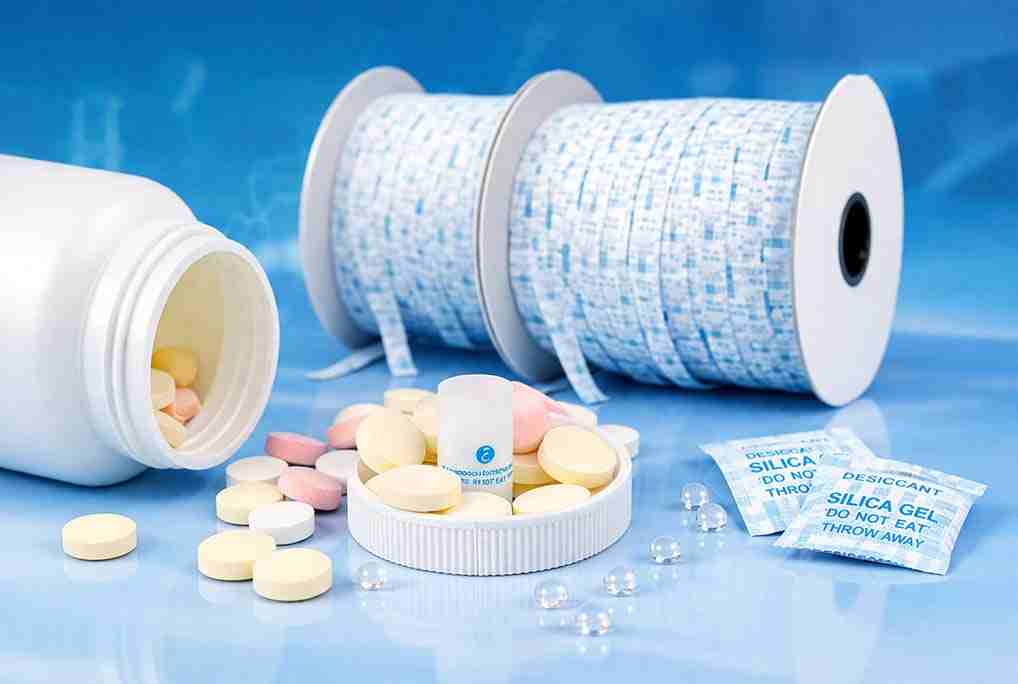
Background
Many pharmaceutical products, especially tablets, capsules, effervescent tablets, traditional herbal granules, and
probiotic formulations, are sensitive to moisture. Excessive humidity inside the package may lead to:
• Moisture absorption and softening of the product
• Caking or agglomeration
• Changes in disintegration performance
• Degradation or loss of active ingredients
• Deformation or sticking of capsule shells
• Increased microbiological risk
• Appearance defects that may affect patient confidence and usability
Therefore, desiccant sachets are commonly placed inside pharmaceutical packaging to control the internal
microenvironment and reduce moisture-related quality risks.
Bottled Vitamin C Effervescent Tablets
1.1 Product Characteristics
Vitamin C effervescent tablets are highly hygroscopic. If exposed to moisture, the tablets may undergo:
• Premature effervescence
• Softening
• Discoloration
• Sticking or clumping
• Reduction in active ingredient potency
1.2 Packaging Configuration
• Packaging container: high-barrier plastic bottle or aluminum-plastic composite tube
• Closure system: sealed cap
• Internal protection: one pharmaceutical-/food-grade silica gel desiccant sachet
1.3 Desiccant Configuration
• Type: Silica gel desiccant
• Typical size: 0.5 g to 2 g, depending on bottle volume, fill quantity, and moisture risk
• Placement: inserted inside the bottle together with the product, while ensuring the sachet remains intact and
does not rupture or directly contaminate the contents
1.4 Application Benefits
Based on accelerated and long-term stability studies, the inclusion of a desiccant sachet can provide the following
benefits:
• Maintains lower relative humidity inside the bottle
• Reduces the risk of moisture-induced product failure
• Preserves tablet appearance and physical integrity
• Improves stability of the active ingredient throughout shelf life
• Reduces customer complaints such as tablets becoming soft or clumping after opening
1.5 Risk Considerations
• The label should clearly state: "Contains desiccant. Do not eat."
• The desiccant material must comply with pharmaceutical packaging safety requirements
• The moisture adsorption capacity of the desiccant should be verified to ensure it is sufficient for the entire intended shelf life
Capsule Products (e.g., Omeprazole Enteric-Coated Capsules)
2.1 Product Characteristics
Certain capsule products are sensitive to humidity due to the capsule shell, the active pharmaceutical ingredient (API), and the enteric or functional coating system. Excess moisture may cause:
• Capsule sticking
• Capsule deformation
• Moisture uptake of fill material
• Reduced coating performance
2.2 Packaging Design
• Packaging container: HDPE pharmaceutical bottle
• Closure with sealing liner
• Internal protection: canister desiccant or desiccant sachet
2.3 Desiccant Type Selection
• Silica gel desiccant: widely used, chemically stable, and generally safe
• Molecular sieve desiccant: stronger moisture control under low-humidity conditions, suitable for highly moisture-sensitive formulations
• Composite desiccant: designed to balance adsorption speed and capacity
2.4 Practical Benefits
Stability studies generally show that, with the inclusion of a desiccant:
• Capsule appearance remains more stable
• The risk of sticking, cracking, or deformation is reduced
• Assay and related substances are more likely to remain within specification
• Packaging robustness is improved and shelf life support is strengthened
Common Types of Desiccants Used in Pharmaceuticals
3.1 Silica Gel Desiccant
• Most commonly used type
• Chemically stable
• Good moisture adsorption capacity
• Relatively high safety profile
Typical applications: tablets, capsules, nutraceuticals/health supplements, and bottled traditional Chinese medicine products.
3.2 Molecular Sieve Desiccant
• Strong adsorption performance even at low relative humidity
• More effective for highly moisture-sensitive products
Typical applications: hydrolysis-sensitive drugs, products requiring stringent moisture control, and small package volumes requiring strong humidity protection.
3.3 Calcium Chloride-Based Composite Desiccant (Use with Caution in Pharmaceuticals)
• High moisture adsorption capacity
• May liquefy after moisture absorption (deliquescence risk)
• Less commonly used for direct inclusion in pharmaceutical primary packaging compared with silica gel or molecular sieve
• Package integrity and leakage risk must be carefully evaluated
Key Control Points for Pharmaceutical Applications
4.1 Compliance Requirements
• The sachet material should be suitable for pharmaceutical or food-contact use
• It should not release harmful volatiles, dust, or odor
• It should not interact with the drug product (e.g., migration, adsorption of API, or other incompatibilities)
• It should comply with internal quality standards and applicable pharmaceutical packaging regulations
4.2 Specification Selection Must Be Verification-Based
The selection of desiccant type, size, and quantity should be determined through evaluation and validation, considering:
• Package/container volume
• Initial moisture content of the product
• Hygroscopicity of the product
• Target shelf life
• Storage conditions (e.g., room temperature, high temperature/high humidity)
• Moisture barrier properties of packaging materials (e.g., HDPE, PET, aluminum composite materials)
4.3 Label Warning
• The packaging or labeling should clearly include a warning such as: "Contains desiccant. Do not eat."
• Special attention should be given to pediatric products to reduce accidental ingestion risk
4.4 Manufacturing and Packaging Line Controls
• Accuracy of desiccant insertion
• Correct placement inside the container
• Prevention of sachet damage or entrapment during sealing
• Visual inspection and/or in-line detection, where applicable
• Verification of container closure integrity after sealing
Summary
The primary function of a desiccant sachet in pharmaceutical packaging is to control internal humidity, reduce moisture-related degradation risks, improve product stability, extend shelf life, and minimize quality complaints.