Key Takeaways
- Molecular sieve's active material — synthetic zeolite crystal — starts out as an extremely fine powder, not the hard bead shape found inside a desiccant packet.
- Turning that powder into usable beads requires a binder, typically a kaolin-type clay making up roughly 10-25% of the finished pellet, plus a small amount of a strength-boosting additive, then a high-temperature firing step.
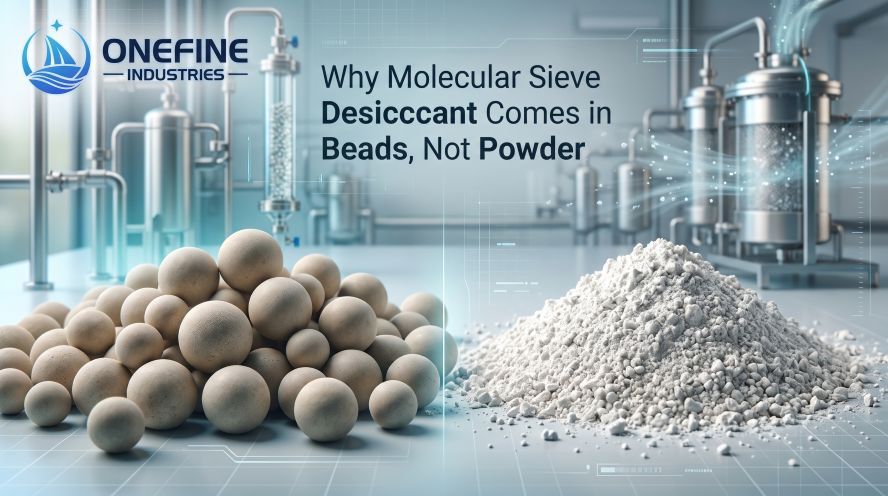
- This manufacturing step is why molecular sieve desiccant is sold as solid, non-dusting beads rather than loose crystalline powder — the raw material simply isn't practical to package or handle in its original form.
Molecular sieve desiccant looks like small, hard, uniform beads — nothing like a fine powder. That's not how the active material starts out. Synthetic zeolite, the crystal structure that gives molecular sieve its strong low-humidity adsorption capability, is manufactured as an extremely fine crystalline powder. Getting from that powder to the beads inside a desiccant packet is a real manufacturing step, and understanding it explains why molecular sieve desiccant always comes in solid bead form.
Why Loose Zeolite Powder Doesn't Work
Fine zeolite crystals on their own create a genuine handling problem. Loose powder packed into any kind of container or flow-through system causes impractically high resistance to airflow, and it's difficult to fluidize or contain. Binding the fine crystals into a larger, solid mass is what makes the material usable at all — not just for packaging convenience, but because loose zeolite powder essentially isn't a workable physical form.
Binding zeolite is also harder than it sounds. The material's natural alkalinity weakens many candidate binders, its crystal particles are too uniform to interlock mechanically, and it swells when wet — all of which limit what can actually hold the powder together.
How Powder Becomes a Bead
Desiccant-manufacturing patent literature describing bonded molecular sieve production lays out the process in four steps:
- Blending — zeolite powder is mixed with a kaolin-type clay binder (patent literature cites a preferred range of roughly 10-25% of the finished pellet, with a broader workable range of 1-40%) and a small amount of a strength-boosting additive (roughly 2-4%), plus enough water to make the mixture pliant.
- Extrusion or pelletizing — the pliant mixture is formed into pellets, typically by extrusion through a die.
- Drying — the formed pellets are dried (patent examples cite around 100°C) to remove excess moisture before firing.
- Firing (activation) — the dried pellets are fired at high temperature, with patent examples citing roughly 600-650°C. This step has to be hot enough to permanently bind the clay and drive off the zeolite's water of hydration, but stay below the temperature at which the zeolite crystal structure itself would start to break down (cited as generally under about 700°C).
The firing step is doing two jobs at once: it's what permanently locks the bead's shape and physical strength, and it's also what activates the zeolite by driving out the water that occupies its pore structure in the as-made state — the same pore structure that gives molecular sieve its adsorption capacity in the first place.
Why This Matters for Desiccant Packaging
This binding and firing process is exactly why molecular sieve desiccant beads behave the way they do in a packet: solid, hard, and non-dusting, rather than a loose powder that would be impossible to contain reliably inside a permeable sachet. The bead form isn't a packaging choice made after the fact — it's a direct consequence of what it physically takes to turn a fine crystalline powder into a usable, robust desiccant material. It's also worth being clear about what binding doesn't change: the specific pore size that determines what molecular sieve can and can't adsorb is a property of the zeolite crystal itself, set before the binder ever gets involved — forming the bead affects handling and durability, not adsorption selectivity.
Key Differences at a Glance
- Raw zeolite crystal: extremely fine powder, high resistance to airflow when loose, difficult to contain or package directly
- Bound and fired bead: clay binder plus firing locks the crystals into a solid, non-dusting pellet while preserving (and activating) the pore structure that performs the actual moisture adsorption
- What doesn't change: the adsorption mechanism itself lives in the zeolite's crystal pore structure — binding and forming the bead doesn't alter how the material adsorbs moisture, only how it's physically handled and packaged
Recommended Products from Onefine
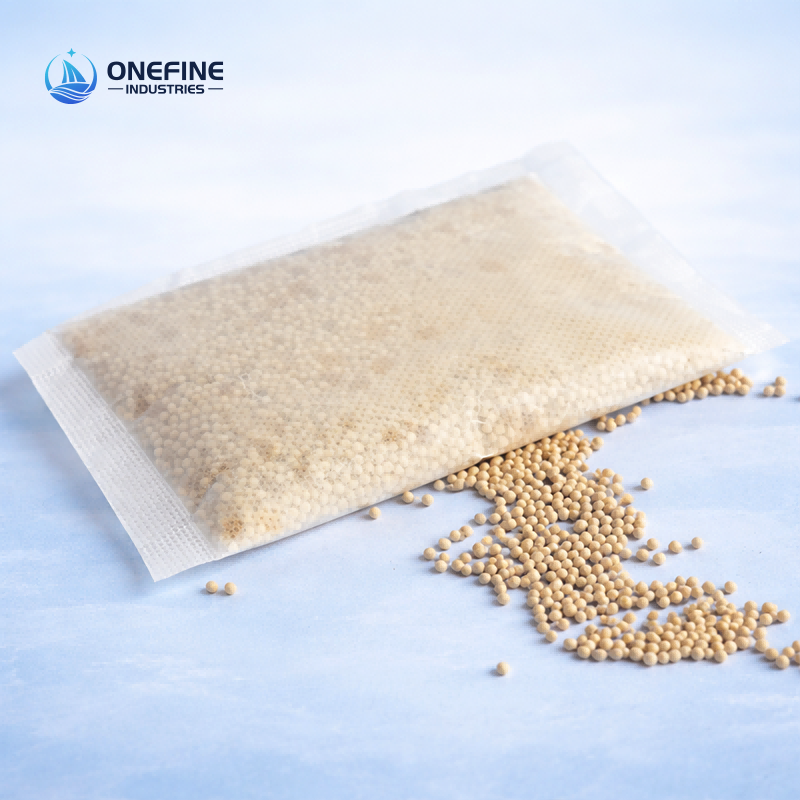
- Molecular Sieve Desiccant Bags — solid bead-form molecular sieve desiccant, packaged for small-pack retail use
Questions About Molecular Sieve Desiccant?
Onefine supplies molecular sieve desiccant in standard bead form, sized for reliable small-pack packaging. Tell us your application, and we'll help you choose the right desiccant.
We provide:
- ✅ Molecular sieve desiccant across a full range of pack sizes
- ✅ Technical support for matching desiccant type to your moisture-sensitivity requirements
- ✅ Custom packaging and private label options
- ✅ Worldwide shipping
- ✅ Multiple desiccant materials if molecular sieve isn't the right fit