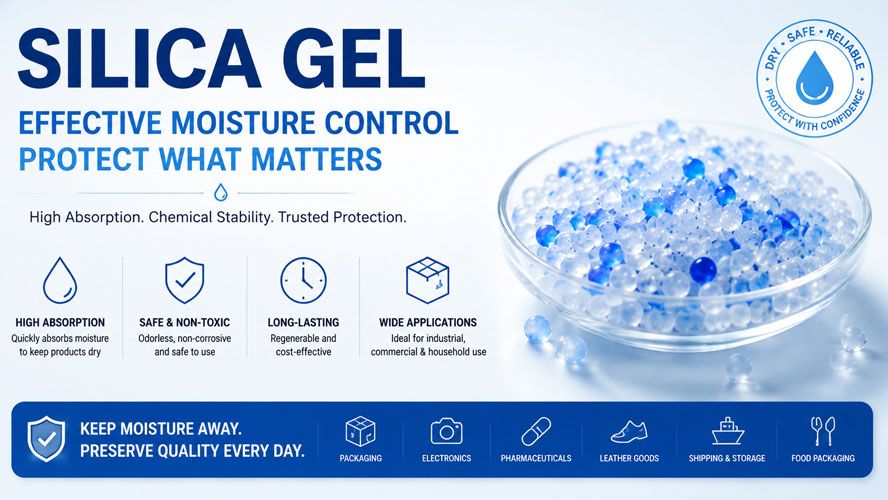
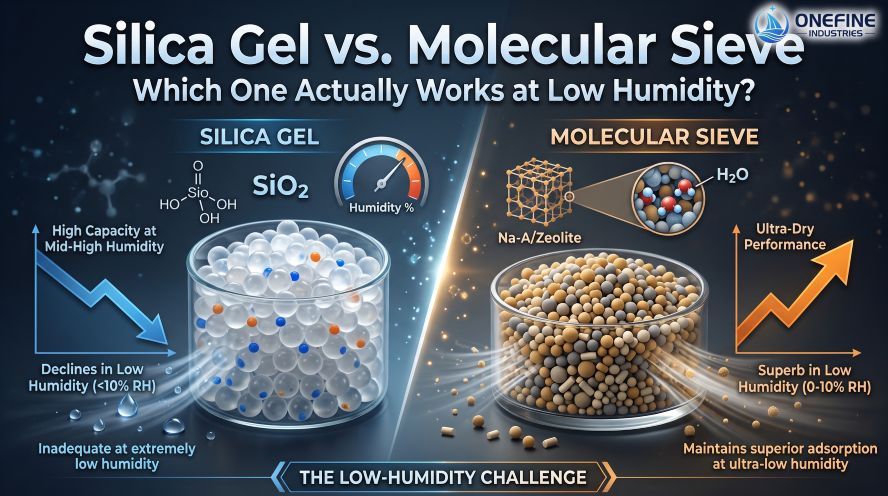
Silica Gel vs. Molecular Sieve: Which One Actually Works at Low Humidity?
Key Takeaways
- Silica gel adsorbs water through surface area and pore-filling, which works well at moderate-to-high humidity but loses most of its pulling power below roughly 20% RH.
- Molecular sieve adsorbs through a fixed, uniform crystalline pore structure that keeps pulling water even at very low RH — independent lab data shows it holding over four times silica gel's capacity at 10% RH.
- Molecular sieve also keeps the water it adsorbs at higher temperatures, while silica gel can desorb moisture back into the package as temperature rises — the two desiccants solve different problems and aren't interchangeable for every application.
Both silica gel and molecular sieve show up in "moisture absorber" sachets, and it's tempting to treat them as interchangeable — just pick whichever is in stock. For most packaging applications, that's close enough. But for products that need to stay genuinely dry — low single-digit relative humidity, not just "not soggy" — the two desiccants behave very differently, and the gap gets wider the drier you need to go.
Two Different Ways of Holding Onto Water
Silica gel is an amorphous, highly porous form of silicon dioxide. Its particles are irregularly shaped, with a huge internal surface area that water vapor molecules physically stick to — adsorption here depends on there being enough water vapor pressure pushing moisture onto that surface. As the surrounding air gets drier, there's less vapor pressure driving that process, so silica gel's pulling power drops off.
Molecular sieve works differently. It's a synthetic, crystalline aluminosilicate — essentially an engineered zeolite — manufactured with a precisely uniform pore size (common grades are labeled 3A, 4A, 5A, and 13X, referring to the pore diameter in angstroms). Because every pore is the same size, molecular sieve adsorbs water through a much stronger, more selective interaction than simple surface adsorption, and that interaction doesn't depend on high vapor pressure to keep working. That's the structural reason molecular sieve keeps adsorbing effectively even when the surrounding air is already very dry.
Why Molecular Sieve Pulls Ahead at Low Humidity
The difference isn't just theoretical. Independent lab testing cited by desiccant supplier Sorbent Systems found that at 10% relative humidity, silica gel's adsorption capacity drops to about 4.6% of its own weight, while molecular sieve still holds about 19.8% — more than four times as much, at the exact RH level where silica gel is already struggling.
That gap shows up in real packaging standards, too. Under military packaging spec MIL-D-3464, where the moisture target is 20% RH (using 3g) or 40% RH (using 6g), silica gel and clay-based desiccants typically require 30-33g to hit the target, while molecular sieve needs roughly 20% less material for the same result. This is also why molecular sieve is the standard choice for applications with genuinely low RH targets — lateral flow diagnostic test strips (often targeting around 10% RH) and semiconductor bake-out procedures (often targeting around 5% RH) are both cited as typical molecular sieve use cases, not silica gel ones.
Where Silica Gel Still Wins
None of this makes silica gel obsolete — it's still the better choice for most general packaging. Silica gel can adsorb up to roughly 40% of its own weight in moisture, which is a higher total capacity than molecular sieve at moderate-to-high humidity levels, where most consumer packaging actually operates. It's also significantly less expensive to produce, and unlike molecular sieve, it can be reactivated by heating and reused rather than treated as single-use. For products where the goal is "keep humidity in a reasonable range," not "hit a specific low-single-digit RH target," silica gel is the more practical and cost-effective option.
Temperature Behavior Is the Other Half of the Story
Humidity control isn't the only place these two desiccants diverge. Molecular sieve can continue holding adsorbed water at temperatures well past 225°C in some conditions, and critically, it does not release that moisture back into the package as temperatures climb. Silica gel behaves the opposite way: as temperature rises, some of the water it's holding can desorb back into the surrounding air — the reverse of what you want from a desiccant. For products that will see heat exposure during shipping, storage, or processing, this temperature stability is a second reason molecular sieve gets specified even when the RH target alone wouldn't demand it.
Key Differences at a Glance
- Adsorption mechanism: Silica Gel — physical surface adsorption, depends on vapor pressure. Molecular Sieve — uniform crystalline pore structure, stronger selective interaction
- Capacity at 10% RH: Silica Gel — approximately 4.6% of its weight. Molecular Sieve — approximately 19.8% of its weight
- Total capacity at moderate-high RH: Silica Gel — up to approximately 40% of its weight. Molecular Sieve — generally lower than silica gel at these levels
- Behavior at high temperature: Silica Gel — can desorb moisture back into the package. Molecular Sieve — continues holding moisture past 225°C in some conditions
- Reusability: Silica Gel — can be reactivated by heating. Molecular Sieve — generally treated as single-use in packaging applications
- Cost: Silica Gel — lower cost, general-purpose. Molecular Sieve — higher cost, used where low-RH or high-temperature performance is required
How to Choose for Your Product
- If your target is general moisture protection (shipping, retail packaging, typical electronics, apparel, food) → Silica Gel Desiccant Sachet covers this at lower cost for most applications.
- If your product needs a specific low-RH target (below roughly 20% RH, or your spec calls for single-digit RH) → Molecular Sieve Desiccant Bags is built for this performance range.
- If your product will see elevated temperatures during storage or shipping → molecular sieve's resistance to moisture desorption at high heat makes it the more reliable choice, even if the RH target alone wouldn't require it.
Recommended Products from Onefine
- Silica Gel Desiccant Sachet — general-purpose moisture protection, lower cost, reactivatable (already linked above)
- Molecular Sieve Desiccant Bags — low-RH and high-temperature performance for specialty applications (already linked above)
Looking for the Right Desiccant for Your RH Target?
Onefine supplies both silica gel and molecular sieve desiccants in retail-ready pack sizes and custom packaging. Tell us your target humidity range and any temperature exposure during shipping or storage, and we'll help you choose — and size — the right material.
We provide:
- ✅ Retail-ready small-pack sizes and custom packaging options
- ✅ Both silica gel and molecular sieve desiccant lines
- ✅ Worldwide shipping
- ✅ Technical support for matching desiccant type to your RH and temperature spec
- ✅ Fast quote response
Related Products
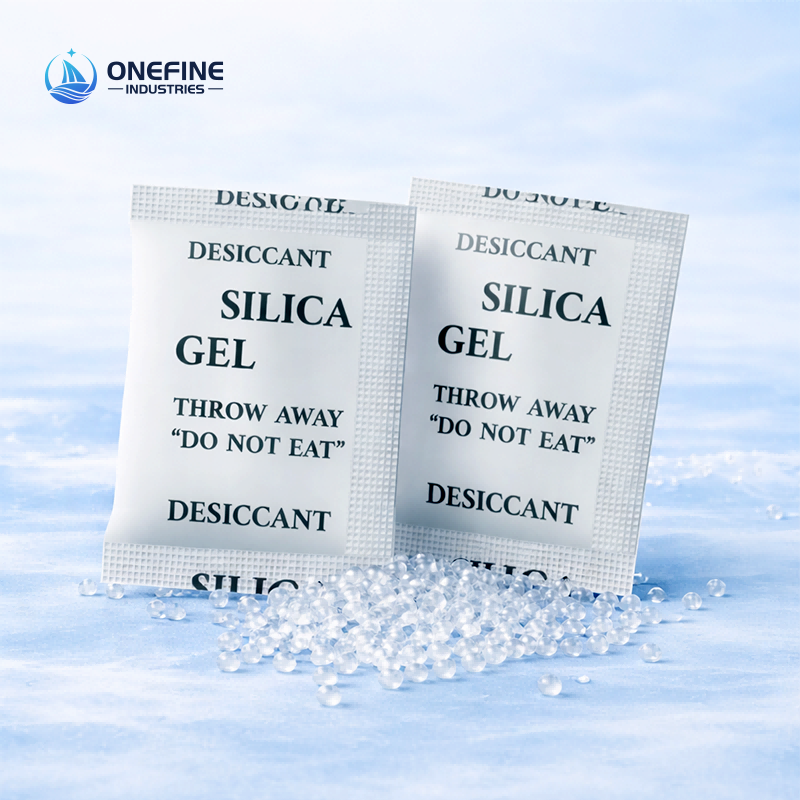
Silica Gel Desiccant Sachet
Silica gel desiccant is a high-performance, non-toxic adsorption material widely used to protect moisture-sensitive products from damage.
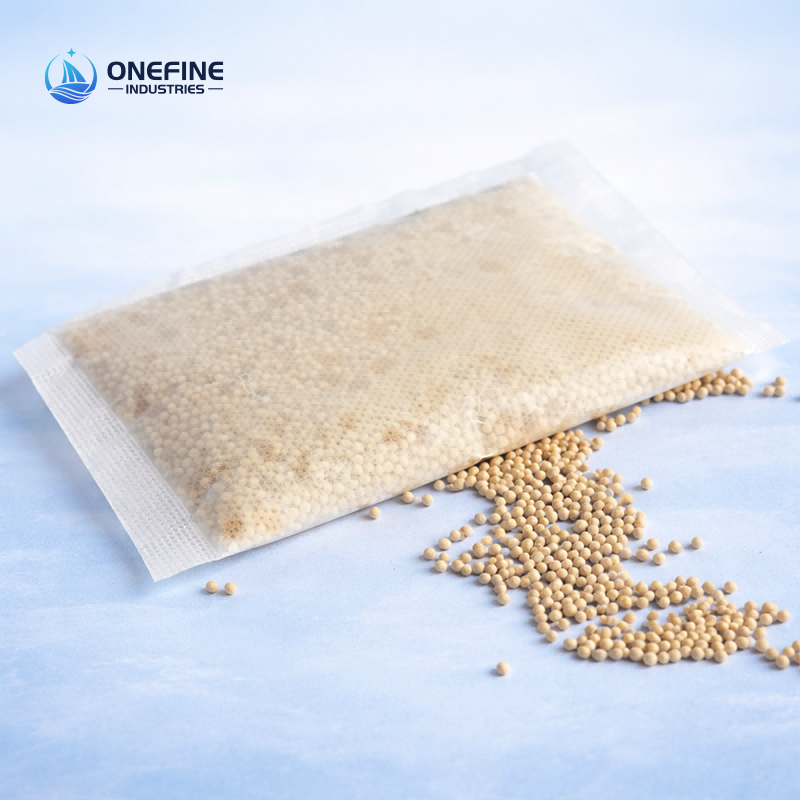
Molecular Sieve Desiccant Bags
Molecular sieve desiccant bags feature a microporous structure that selectively adsorbs molecules based on pore size, delivering deep drying performance for gases and liquids.
Related Reading

Moisture Risk in Battery Storage Enclosures: It's Not the Cells, It's the Box Around Them
Lithium battery cells are hermetically sealed, so it's easy to assume moisture isn't a storage concern. But the enclosure around those cells isn't sealed the same way — and that's where real moisture damage happens. Here's the actual mechanism, and what a desiccant inside the enclosure does and doesn't protect against.

How to Prevent "Container Rain" and Protect Your Cargo
Container rain can quietly destroy an entire shipment before it reaches port. Here's what causes it, what it costs exporters, and how the right desiccant stops it before it starts.