Key Takeaways
- Pharmaceutical packaging in the US is measured against a specific compendial standard, USP General Chapter <671>, which classifies containers by exactly how much moisture actually gets through them — not by a general description like "moisture-resistant."
- The classification method is unusual: desiccant itself is used as the literal measuring instrument, with its weight gain over a set test period showing precisely how much water vapor the packaging let through.
- This numeric, class-based system is why desiccant packaging conventions in the pharmaceutical industry look different from general retail or industrial desiccant use — the sizing isn't arbitrary, it's built around specific permeation thresholds.
Most packaging gets described as "moisture-resistant" without much more detail than that. Pharmaceutical packaging in the US doesn't get that luxury — it's measured against a specific numeric standard, USP General Chapter <671> ("Containers—Performance Testing"), published by the United States Pharmacopeia. Understanding how that standard actually works explains a lot about why desiccant formats and weight ranges in pharmaceutical packaging look different from general retail or industrial desiccant use.
How the Standard Actually Measures "Moisture-Resistant"
USP <671> doesn't rely on a material description or a general barrier rating. It runs a gravimetric test: desiccant (calcium chloride, silica gel, or molecular sieve, each with its own specified pre-drying step) is placed inside the container, the container is held at a controlled temperature and humidity, and the desiccant's weight gain over time is measured. Since the desiccant is absorbing whatever moisture makes it through the packaging, its weight gain directly tells you the container's real moisture vapor transmission rate (MVTR).
For single-unit and unit-dose containers — blister packs, in practice — the standard sets four classes based on that measured permeation rate, expressed in milligrams of water per day:
- Class A: no more than 1 of 10 tested units exceeds 0.5 mg/day, and none exceeds 1 mg/day
- Class B: no more than 1 of 10 exceeds 5 mg/day, none exceeds 10 mg/day
- Class C: no more than 1 of 10 exceeds 20 mg/day, none exceeds 40 mg/day
- Class D: fails the Class C limits
For multiple-unit containers like bottles, the classification instead distinguishes "tight" (no more than 1 of 10 exceeds 100 mg/day/L, none exceeds 200) from "well-closed" (no more than 1 of 10 exceeds 2000 mg/day/L, none exceeds 3000) — a roughly 20x gap between the two tiers.
Testing conditions are specified too: barrier determination for solid oral dosage forms runs at 40°C/75% relative humidity (matching standard accelerated stability testing conditions), with the container weighed at days 7, 14, 21, 28, and 35 to calculate the permeation rate from the weight-gain trend.
Why This Changes How Desiccant Gets Sized
We've covered how to calculate desiccant quantity using the military packaging standard MIL-D-3464, which sizes desiccant against container volume and a fixed target relative humidity. USP <671> works on a different logic entirely — it's not sizing desiccant to protect a product, it's classifying the packaging itself by how little moisture it lets through in the first place, with desiccant used only as the test instrument. A Class A blister and a Class C blister can both be sealed and sold, but they represent genuinely different moisture-barrier performance, and a drug product's own stability data determines which class its packaging actually needs to meet.
This is also part of why pharmaceutical desiccant packaging conventions — narrower weight increments than general retail packaging, specifically engineered for small bottle and blister formats — aren't an arbitrary industry habit. They exist because the packaging system as a whole is being held to a quantified permeation standard, and the desiccant inside it is one part of a packaging system that has to perform to a specific numeric class, not just "keep things dry in general."
What This Means for Choosing Pharmaceutical Packaging Desiccant
- A drug product's actual moisture sensitivity (established through its own stability testing) determines which USP <671> class its packaging needs to meet — the desiccant format and amount should match that requirement, not a generic rule of thumb
- Blister packaging and bottle packaging are classified under different systems within USP <671> (mg/day per unit for blisters vs. mg/day/L for bottles), so the two formats aren't directly comparable on the same scale
- This compendial classification standard is specific to pharmaceutical and dietary-supplement packaging in the US market — it's a different framework from general packaging desiccant-sizing methods like MIL-D-3464
Key Differences at a Glance
- MIL-D-3464 (general/military packaging): sizes desiccant quantity against container volume and a target relative humidity — a sizing calculation for protecting the product inside
- USP <671> (pharmaceutical packaging): classifies the packaging system itself by measured moisture permeation rate, using desiccant weight gain as the test method — a performance classification, not a sizing formula
- What they share: both ultimately exist to answer the same underlying question — how much moisture is actually getting to the product — just through different measurement logic for different industries
Recommended Products from Onefine
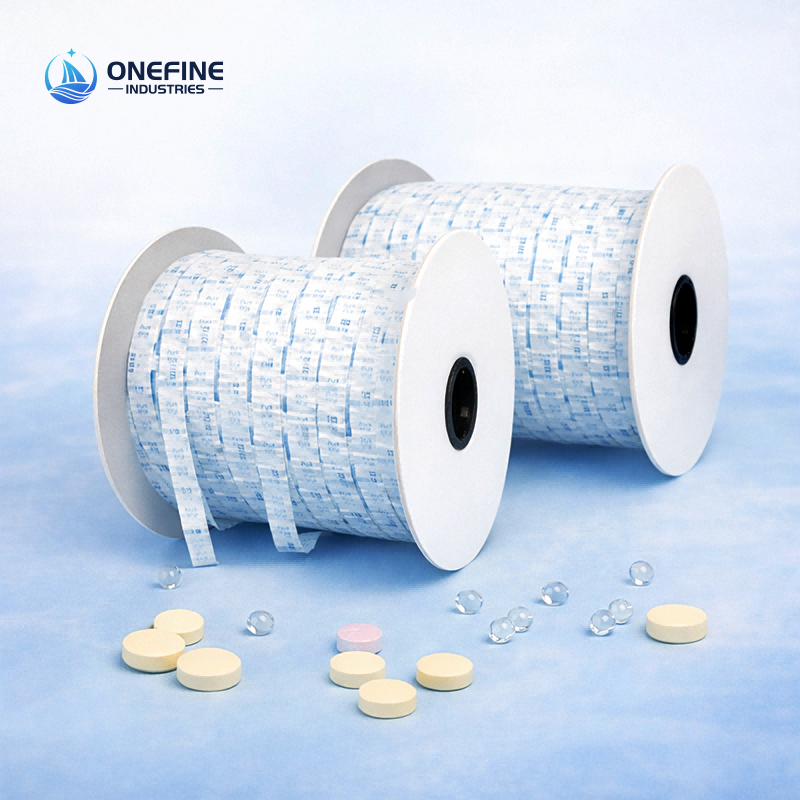
- Pharmaceutical Desiccant Strips — sized for bottle and blister pack formats common in pharmaceutical and dietary-supplement packaging
Questions About Pharmaceutical Packaging Desiccant?
Onefine supplies desiccant strips sized for pharmaceutical bottle and blister packaging formats. Tell us about your packaging and moisture-sensitivity requirements, and we'll help you choose the right format.
We provide:
- ✅ Desiccant strips in pharmaceutical bottle/blister-compatible weight ranges
- ✅ Technical support for matching desiccant format to your packaging type
- ✅ Custom packaging and private label options
- ✅ Worldwide shipping
- ✅ Multiple desiccant materials across our product range