Key Takeaways
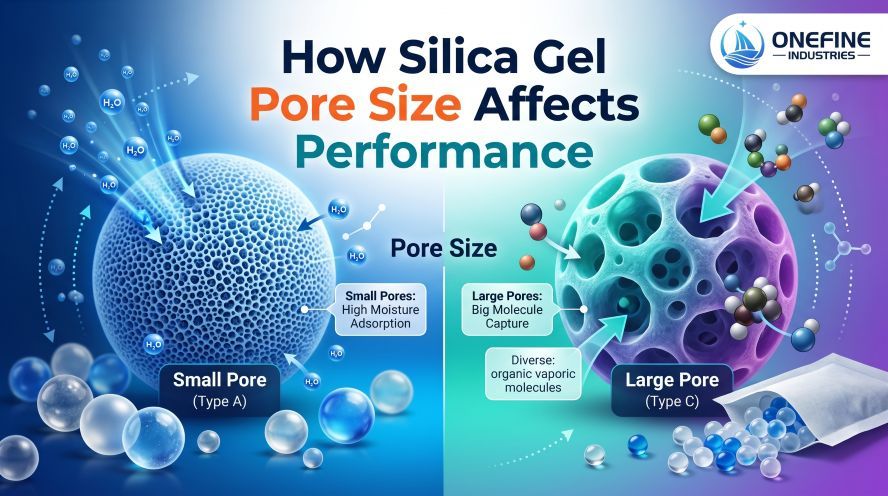
- Silica gel's pore size isn't just a manufacturing detail — it directly determines the shape of its water-adsorption curve, which is why different silica gel grades are better suited to different humidity ranges.
- By the IUPAC classification used in desiccant engineering, micropores (roughly 2 nm / 20 Å or smaller) produce strong uptake at low relative humidity, while larger mesopores shift most of the uptake toward high relative humidity, near saturation.
- The energy involved in silica gel's water uptake is close to the heat of simple condensation, which is consistent with physical adsorption rather than a chemical reaction — the opposite mechanism from an iron-based oxygen absorber.
Silica gel desiccant isn't one single material with one fixed behavior. Two products both labeled "silica gel" can perform quite differently depending on their internal pore structure, and that difference is not cosmetic — it changes where in the humidity range the desiccant actually does its best work.
Why Pore Size Changes the Shape of the Uptake Curve
Desiccant-engineering research on controlled-pore-size silica gels uses the IUPAC classification: micropores are defined as roughly 20 Å (about 2 nm) or smaller, while mesopores span roughly 20 to 500 Å. This isn't just a labeling convention — it tracks a real difference in adsorption behavior:
- Microporous silica gel produces what's called a Type I adsorption isotherm — most of the water uptake happens at low relative pressure (i.e., low humidity), and the curve flattens out early rather than continuing to climb as humidity rises further
- Larger-pore (mesoporous) silica gel tends toward a more linear or Type II isotherm, where uptake keeps increasing toward saturation — meaning its strongest performance, and its highest total capacity, shows up at higher humidity levels, not low ones
In practical terms: a silica gel engineered with predominantly micropores will keep working at pulling moisture even when the surrounding air is already fairly dry, while a silica gel with larger pores needs more humidity present before it really starts to perform — but can often hold more total moisture once conditions get there.
Why This Is Physical Adsorption, Not a Chemical Reaction
The same body of research on silica gel's sorption behavior measured the isosteric heat of adsorption — the energy released as water molecules bind to the silica surface — at roughly 10.3 to 13.1 kcal/mol depending on how much moisture has already been adsorbed. For comparison, the heat of liquefaction of water (the energy released when water vapor simply condenses into liquid) is about 10.6 kcal/mol. These numbers sit close together, which is the signature of physical adsorption: water molecules are binding to the silica surface through forces not far removed from ordinary condensation, not forming new chemical compounds.
This is worth contrasting directly with how an iron-based oxygen absorber works: an oxygen absorber consumes oxygen through an actual oxidation reaction that permanently converts the iron into a different compound. Silica gel does the opposite — nothing is chemically transformed, which is exactly why it can be dried out and reused, while an oxygen absorber cannot.
What This Means When Choosing or Sizing Silica Gel
- If your package or container is expected to sit in a consistently low-humidity environment, a microporous silica gel grade that performs well at low RH is doing more useful work than one optimized for high-humidity capacity
- If the concern is occasional humidity spikes or storage in a more humid environment, a grade with more capacity concentrated toward higher RH may be the better match
- Either way, "silica gel" on a spec sheet is not a single fixed performance curve — the pore structure behind it is what actually determines where that curve does its work
Key Differences at a Glance
- Micropore-dominant silica gel (≲2 nm / 20 Å pores): Type I isotherm — strong uptake starting at low relative humidity, capacity plateaus earlier
- Mesopore-dominant silica gel (roughly 2-50 nm / 20-500 Å pores): Type II/linear isotherm — uptake concentrated toward high relative humidity, near saturation
- Adsorption mechanism: physical (van der Waals-type surface binding), energetically close to simple water condensation — not a chemical reaction
- Reversibility: fully reactivatable by heating, since nothing is chemically changed
Recommended Products from Onefine
- Silica Gel Desiccant Sachet — general-purpose silica gel desiccant, available across our standard pack-size range (already linked above)
Need the Right Silica Gel Grade for Your Humidity Range?
Onefine supplies silica gel desiccant sized for your actual storage conditions. Tell us your typical humidity range and storage duration, and we'll help you choose accordingly.
We provide:
- ✅ General-purpose silica gel desiccant across a full range of pack sizes
- ✅ Technical support for matching desiccant performance to your actual humidity conditions
- ✅ Custom packaging and private label options
- ✅ Worldwide shipping
- ✅ Multiple desiccant materials if silica gel isn't the right fit
Related Reading
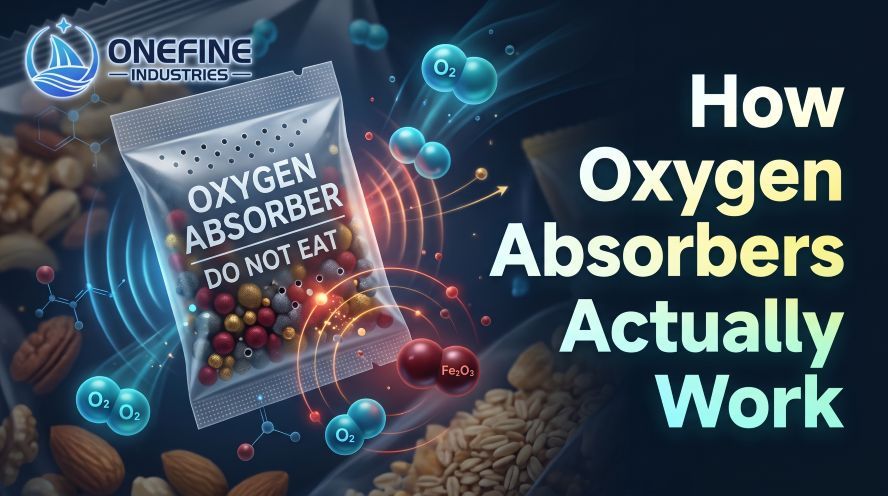
How Oxygen Absorbers Actually Work
An oxygen absorber sachet is not a desiccant in disguise. It works through an actual iron oxidation reaction that consumes oxygen as it runs, and that reaction needs a bit of moisture to proceed. Here is the real chemistry behind it.
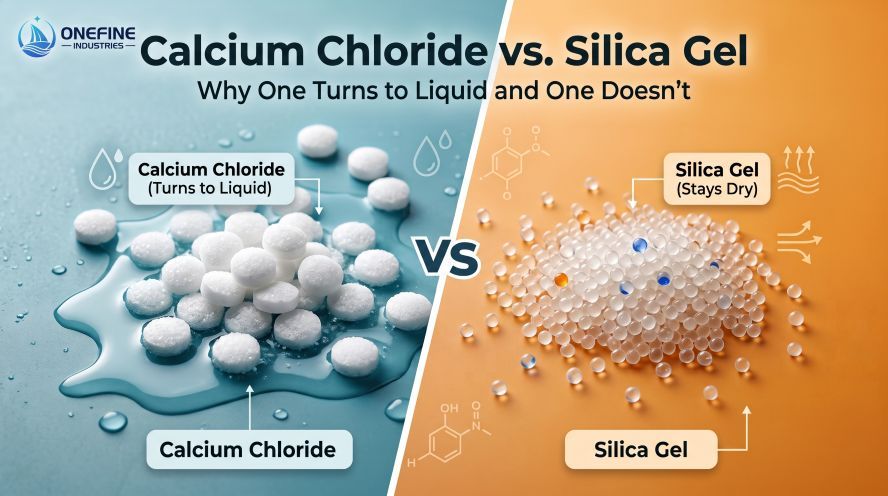
Calcium Chloride vs. Silica Gel: Why One Turns to Liquid and One Doesn't
Calcium chloride and silica gel are often treated as interchangeable desiccants, but one is deliquescent and one is not. Here is the humidity threshold that explains the difference, and what it means for your packaging.