Calcium Chloride vs. Silica Gel: Why One Turns to Liquid and One Doesn't
Key Takeaways
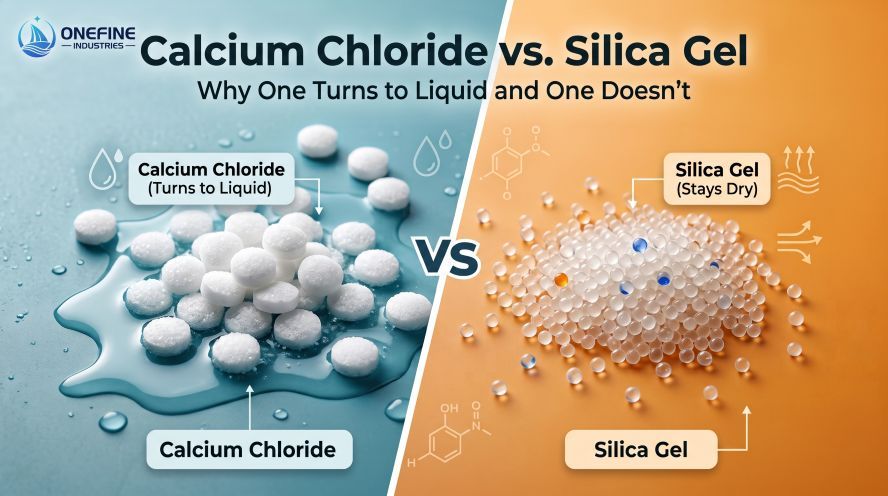
- Calcium chloride is a deliquescent salt — above a specific humidity threshold (its "critical relative humidity," roughly 33% RH at 20°C) it continuously absorbs water and dissolves into a liquid brine, rather than staying solid.
- Silica gel is a physical adsorbent, not deliquescent — it holds water inside its pore structure and stays a dry, solid granule at any humidity level, with capacity increasing smoothly as RH rises rather than switching behavior at a threshold.
- Neither desiccant is "stronger" in the abstract — the deliquescent-vs-non-deliquescent distinction determines whether a desiccant stays contained in solid form or can turn into a liquid that needs somewhere to go, which matters directly for packaging design.
Calcium chloride and silica gel both show up constantly in desiccant packaging, and it's easy to assume the choice between them is just a matter of degree — one "absorbs more," one "absorbs less." That's not really the right way to think about it. The two materials work through fundamentally different mechanisms, and that difference shows up physically in a way you can actually see: one of them turns into liquid, and the other one doesn't.
Calcium Chloride: A Deliquescent Salt
Calcium chloride is deliquescent, meaning it's a salt that, above a specific relative humidity level, will spontaneously absorb water vapor from the air and dissolve into its own saturated solution — a liquid brine — rather than remaining a solid. This threshold is called the critical relative humidity (or deliquescence RH), and for calcium chloride it sits at roughly 33% RH at 20°C, based on established research on salt-humidity equilibria. Below that threshold, calcium chloride exists as one of several solid hydrate forms (it can hold onto water molecules in a stepped sequence — tetrahydrate, dihydrate, monohydrate — each stable in its own narrower humidity band). Once the surrounding air crosses that ~33% RH line, it stops being a solid salt holding onto a few water molecules and starts behaving as a liquid solution that keeps drawing in more water as long as humidity stays above the threshold.
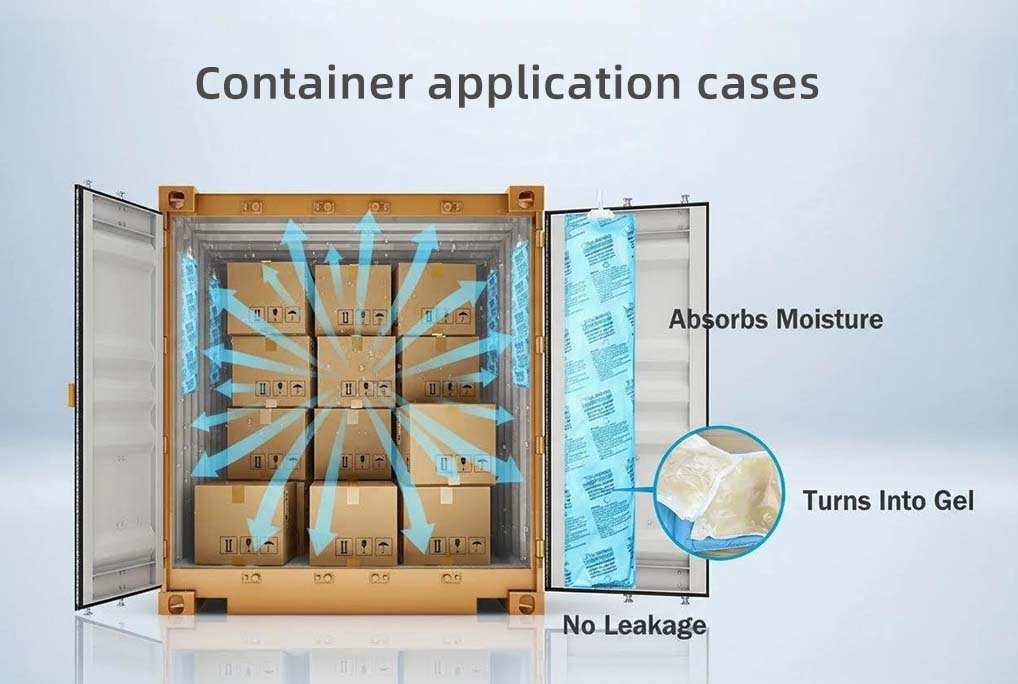
This is why calcium chloride desiccant products are often sold in sealed containers with absorption chambers — the container isn't just packaging, it's functionally necessary once the material does what it's chemically designed to do and turns to liquid.
Silica Gel: A Physical Adsorbent, No Threshold Involved
Silica gel works on a completely different principle. It's not deliquescent at all — it's a physical adsorbent, meaning water vapor molecules are drawn into and held within its network of microscopic pores (typically in the 20-30 angstrom range) through surface forces, not a chemical reaction or dissolution. Because of this, silica gel's moisture uptake scales smoothly and predictably with humidity rather than switching behavior at a threshold: industry reference data for a standard silica gel desiccant shows minimum adsorption of roughly 11% of its own weight at 20% RH, climbing to roughly 22% at 40% RH and roughly 33% at 80% RH. There's no humidity level at which silica gel suddenly starts behaving differently — it stays a dry, pourable granule at every point on that curve, all the way up to its saturation point.
Why the Mechanism Difference Actually Matters
This isn't just a chemistry curiosity — it has direct, practical consequences for packaging:
- Containment requirements differ. A deliquescent desiccant that can turn liquid needs a container designed to hold that liquid once it forms. A non-deliquescent desiccant like silica gel stays solid and granular regardless of how much moisture it has absorbed, which is part of why it works in simple sachets and pouches without a dedicated containment chamber.
- Behavior near saturation differs. Calcium chloride, once above its critical RH, keeps absorbing as long as moisture is available — its capacity isn't capped the way a fixed pore volume caps silica gel's. Silica gel's capacity is set by its physical pore structure, so it approaches a defined saturation point rather than continuing indefinitely.
- Reusability differs. Silica gel can typically be reactivated by driving off the adsorbed water with heat, since the water was never chemically reacted with the material. Calcium chloride's deliquescence is a different kind of process — once it has dissolved into brine, it isn't a simple reversal back to the original solid form the way reactivating silica gel is.
Key Differences at a Glance
- Mechanism: Calcium Chloride — deliquescent salt, dissolves into liquid brine above a threshold. Silica Gel — physical adsorption into pore structure, no threshold
- Behavior above critical RH (~33% for CaCl₂): Calcium Chloride — becomes a liquid solution, keeps absorbing. Silica Gel — no equivalent threshold; stays solid at any RH
- Physical form at saturation: Calcium Chloride — liquid brine. Silica Gel — dry, solid granule
- Containment needs: Calcium Chloride — typically needs a sealed chamber to hold the eventual liquid. Silica Gel — works in simple sachets/pouches
- Reactivation: Calcium Chloride — not simply reversible once deliquesced. Silica Gel — commonly reactivatable by driving off water with heat
How to Choose for Your Product
- If your packaging can accommodate a sealed absorption chamber, and your priority is handling high, sustained humidity loads → Calcium Chloride Desiccant Packets uses deliquescence to keep absorbing well past where a fixed-pore material would plateau.
- If your packaging is a simple sachet or pouch, and you need the desiccant to stay solid and clean regardless of saturation level → Silica Gel Desiccant Sachet stays dry and granular at every point on its adsorption curve.
- Both are genuine, widely used desiccants — the right choice depends on your containment design and humidity conditions, not on one material being categorically "stronger."
Recommended Products from Onefine
- Calcium Chloride Desiccant Packets — deliquescent salt desiccant, suited to higher sustained humidity loads with appropriate containment (already linked above)
- Silica Gel Desiccant Sachet — non-deliquescent physical adsorbent, stays solid and reactivatable (already linked above)
Not Sure Which Desiccant Fits Your Packaging?
Onefine supplies both calcium chloride and silica gel desiccants in retail-ready pack sizes. Tell us your containment design and expected humidity range, and we'll help you pick the right mechanism for your product.
We provide:
- ✅ Both calcium chloride and silica gel desiccant lines
- ✅ Retail-ready small-pack sizes and custom packaging options
- ✅ Worldwide shipping
- ✅ Technical support for matching desiccant mechanism to your packaging design
- ✅ Fast quote response
Related Products
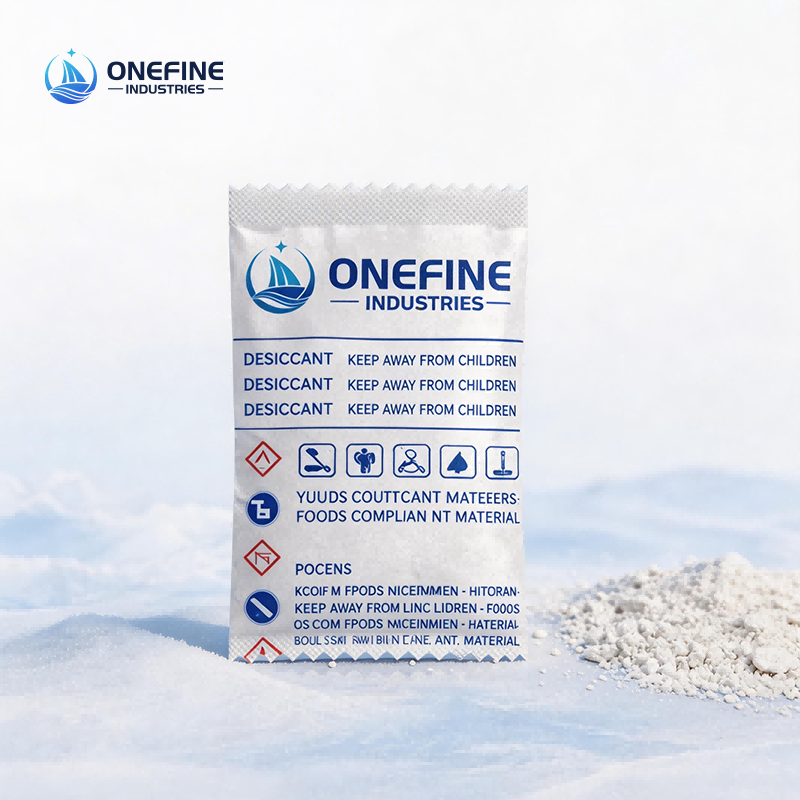
Calcium Chloride Desiccant Packets
Calcium chloride desiccant packets are a highly effective moisture-absorbing solution designed to prevent "container rain" and condensation damage during shipping and storage.
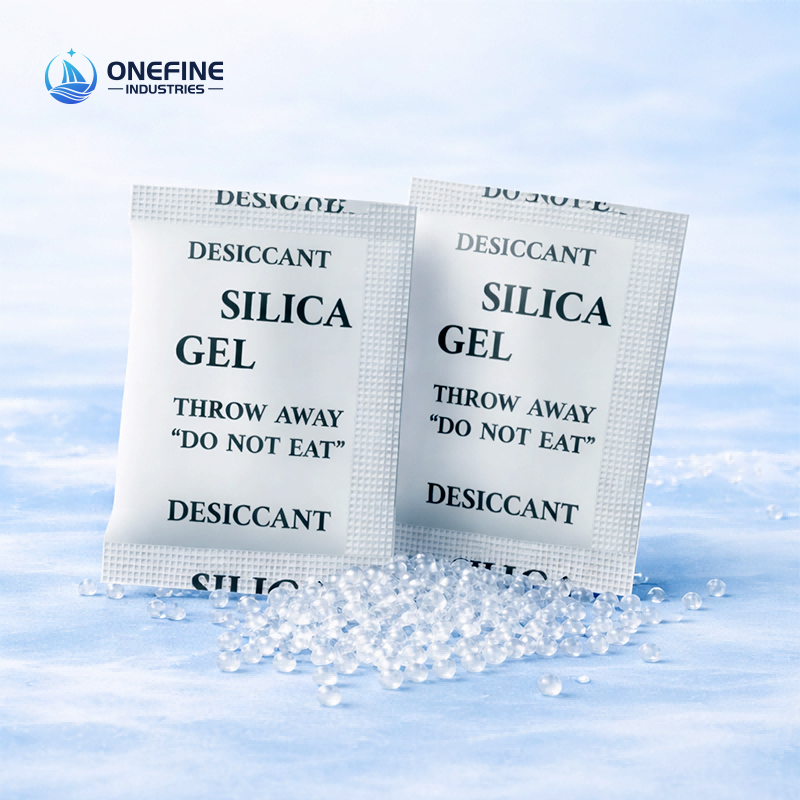
Silica Gel Desiccant Sachet
Silica gel desiccant is a high-performance, non-toxic adsorption material widely used to protect moisture-sensitive products from damage.
Related Applications

Related Reading
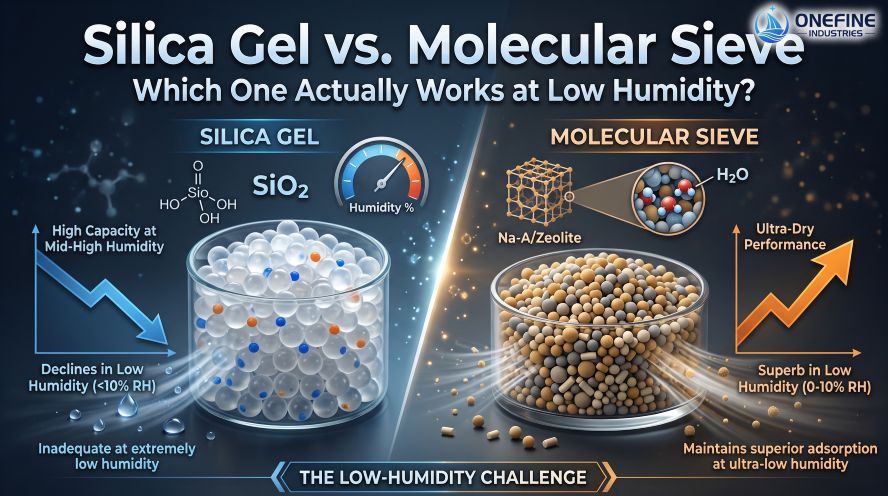
Silica Gel vs. Molecular Sieve: Which One Actually Works at Low Humidity?
Silica gel and molecular sieve are both common desiccants, but they work through different mechanisms, and that difference matters most at low relative humidity. Here's what actually happens at the molecular level, and when each one is the right choice.

How Much Desiccant Do You Actually Need?
Desiccant packaging follows a real industry standard (MIL-D-3464), not guesswork. Here's how the unit-based formula actually works, a worked example, and what the simplified version leaves out.