Key Takeaways
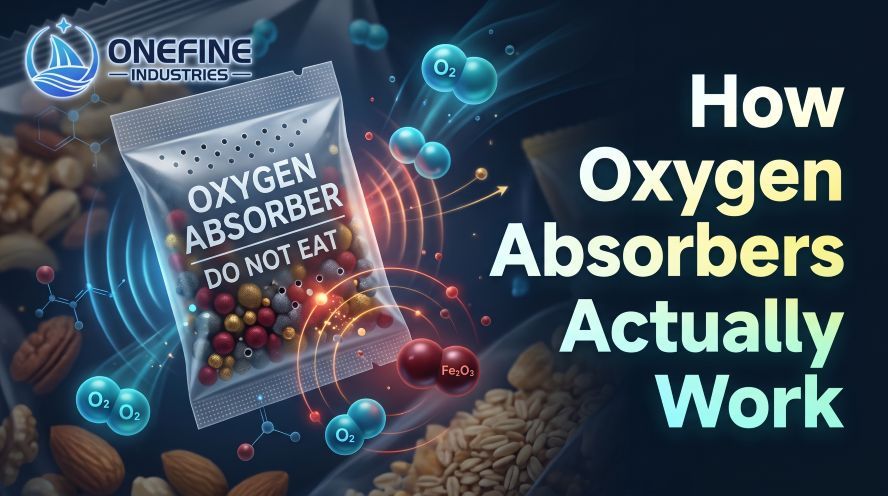
- An oxygen absorber sachet works through genuine iron oxidation chemistry — the same basic reaction behind rust — and it physically consumes oxygen gas from the sealed package, rather than adsorbing moisture the way a desiccant does.
- Counterintuitively, this reaction needs a small amount of moisture to proceed, and reaction kinetics research shows both temperature and humidity directly affect how fast it runs.
- Salts (like sodium chloride) act as a catalyst that measurably speeds up the reaction — which is part of why real oxygen absorber formulations aren't just "iron powder in a bag."
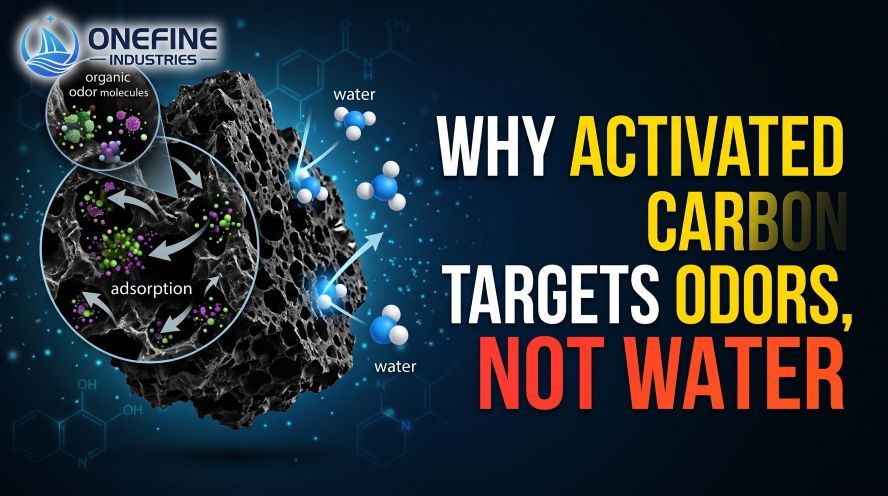
Oxygen absorbers and desiccants often sit side by side in a packaging catalog, and it's easy to assume they're just two flavors of the same thing — something that "keeps a package dry and fresh." They're not. A desiccant adsorbs water vapor; an oxygen absorber runs an actual chemical reaction that consumes oxygen gas. Understanding that reaction explains some things about oxygen absorbers that otherwise seem strange — like why they need a bit of humidity to work well.
The Reaction: Iron Oxidation, the Same Chemistry as Rust
Iron-based oxygen absorbers work through the same basic oxidation reaction that produces rust on exposed steel: iron reacts with oxygen and water to form iron hydroxide/oxide compounds, consuming oxygen gas from the surrounding air in the process (the general reaction is often written as 4Fe + 3O₂ + 6H₂O → 4Fe(OH)₃). This is a genuine chemical reaction, not a physical adsorption process — the oxygen molecules are consumed and converted into a solid compound, not just captured on a surface the way water vapor is captured by silica gel's pores.
This is also the core mechanistic difference from a desiccant. A desiccant like silica gel can, in principle, be reactivated by driving the adsorbed water back out with heat, because nothing was chemically changed. An oxygen absorber's iron has been chemically converted into a different compound — there's no equivalent "reactivation," because the reaction isn't reversible the way physical adsorption is.
Why Oxygen Absorbers Actually Need Some Moisture
Because the reaction is a genuine oxidation process (the same one behind rust formation), it needs water to proceed — completely dry iron in a completely dry atmosphere oxidizes extremely slowly. Research on iron-based oxygen absorbing systems for food packaging has used response-surface modeling to find the conditions that maximize absorption rate, identifying a peak absorption rate of roughly 6.54% of the package's oxygen per hour under specific conditions of elevated temperature, humidity, and a small percentage of sodium chloride (NaCl) added as a catalyst — the research explicitly treats humidity as one of the variables that directly affects how fast the reaction runs, not an irrelevant side factor.
This is why oxygen absorber sachets aren't simply "iron powder in a bag" — real formulations include catalysts like salt specifically to keep the reaction running at a usable rate, and it's also why an oxygen absorber placed in an extremely dry environment can underperform compared to the same product in a moderately humid one, since the reaction it depends on is moisture-dependent by its basic chemistry.
What This Means for Choosing Between Desiccant and Oxygen Absorber
Because the mechanisms are genuinely different, the two products solve different problems rather than competing on the same spec:
- If the goal is removing water vapor specifically (preventing caking, mold, moisture damage) → a desiccant is the right tool, since it's built to adsorb water vapor directly
- If the goal is removing oxygen specifically (preventing oxidative rancidity, preserving color, slowing microbial growth in low-moisture foods) → an oxygen absorber is the right tool, since it's built to chemically consume oxygen gas
- Many packaged products benefit from both — a desiccant to control moisture and an oxygen absorber to control oxidation — and the two don't substitute for each other because they're solving chemically distinct problems
Key Differences at a Glance
- Mechanism: Oxygen Absorber — genuine iron oxidation (chemical reaction), same chemistry as rust. Desiccant (e.g. silica gel) — physical adsorption onto pore surfaces, no chemical reaction
- What it removes: Oxygen Absorber — oxygen gas. Desiccant — water vapor
- Moisture relationship: Oxygen Absorber — needs some moisture to run the reaction at a usable rate. Desiccant — actively removes moisture
- Reversibility: Oxygen Absorber — not reactivatable (the iron is chemically converted, one-way). Desiccant (silica gel) — commonly reactivatable by driving off adsorbed water with heat
- Typical sizing unit: Oxygen Absorber — cc of oxygen absorption capacity. Desiccant — gram weight or MIL-D-3464-style units
Recommended Products from Onefine
- Food Oxygen Absorber Sachets — iron-based oxidation chemistry, sized by cc capacity for specific package oxygen volumes (already linked above)
Need Oxygen Control, Moisture Control, or Both?
Onefine supplies both oxygen absorbers and desiccants, so your packaging doesn't have to guess which mechanism it needs. Tell us what you're protecting against — oxidation, moisture, or both — and we'll help you choose the right product.
We provide:
- ✅ Both oxygen absorber and desiccant product lines
- ✅ cc-capacity sizing for oxygen absorbers to match your package volume
- ✅ Retail-ready small-pack sizes and custom packaging options
- ✅ Worldwide shipping
- ✅ Technical support for matching the right product to your packaging goal