Key Takeaways
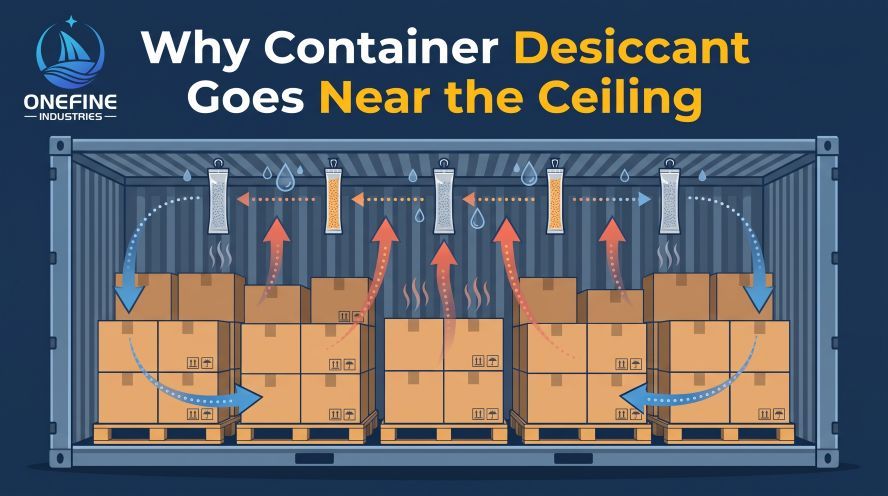
- Warm, moisture-laden air inside a sealed shipping container rises and collects near the ceiling, where it cools and condenses — this is why desiccant placed on the floor does comparatively little against "container rain."
- Loss-prevention guidance from a container-transport industry reference puts desiccant in the upper third of the container, directly under the ceiling, and explicitly marks floor-level placement as the wrong approach.
- Desiccant also needs to stay physically separated from the cargo itself — a saturated desiccant bag can release absorbed moisture (and, for some formulations, dissolved salts) back into direct contact with goods, so placement has a second job besides absorbing moisture.
Getting the right amount of desiccant into a shipping container is only half the problem. Where that desiccant actually sits matters just as much — and the physics behind "container rain" explains exactly why.
Why Moisture Collects at the Ceiling First
Inside a sealed container, warm, moisture-laden air rises — basic convection. As outside temperatures fall during transit, that warm, humid air layer sitting just under the ceiling cools against the metal roof panel and produces condensation, the "sweat" that becomes container rain once it accumulates enough to drip onto cargo below. A container-transport industry loss-prevention reference puts a specific number on the threshold: keeping the air's dew point below roughly 20°C (equivalent to about 54% relative humidity) is what avoids this sweating in the first place.
This is also why desiccant placed on the floor of a container, or buried low among palletized cargo, is working against the physics rather than with it. The moisture problem concentrates at the top of the container, not the bottom, because that's where the warm, humid air naturally collects before it cools and condenses.
Where Desiccant Actually Needs to Go
The same loss-prevention guidance is explicit on this point: desiccant should be placed in the upper third of the container, directly under the ceiling — and placement at the bottom is specifically flagged as the wrong approach. The logic follows directly from the condensation mechanism: desiccant positioned near the ceiling is absorbing moisture from the same rising, humid air layer before it has a chance to cool and condense on the metal roof, rather than trying to catch problems after they've already started dripping onto cargo.
There's a second placement rule worth knowing, and it's easy to miss: desiccant should be kept physically separated from the cargo it's protecting, not stacked directly against it. A desiccant bag that's absorbed moisture toward its capacity can release some of that moisture back out, and for calcium chloride-based desiccant specifically, it can also release dissolved salts — both of which are a real problem if they're in direct contact with the goods rather than positioned nearby. Placement, in other words, isn't only about absorbing moisture efficiently; it's also about keeping a saturated desiccant unit from becoming its own contact-damage risk late in a long transit.
What This Means for Choosing Container Desiccant Format
- Knowing how much desiccant a container needs is a separate calculation from where it goes — both have to be right, since the correct quantity placed in the wrong location won't intercept the moisture before it condenses
- A rod or strip format, designed to hang from a container wall or corner near the ceiling, matches the upper-third placement guidance more naturally than a bag set on the floor or wedged between pallets
- Keep desiccant positioned away from direct cargo contact, particularly for longer transit routes where a desiccant unit has more time to approach saturation
Key Differences at a Glance
- Floor or low placement: sits below where moist air actually collects, works against the container's natural convection pattern, slower to intercept moisture before it condenses on the ceiling
- Upper-third/ceiling placement: positioned in the same air layer where moisture concentrates first, matches the physics of how container rain actually forms
- Direct cargo contact (either placement): risks releasing absorbed moisture or dissolved salts back onto goods once a desiccant unit nears saturation — a separate issue from where in the container it sits vertically
Recommended Products from Onefine
- Container Desiccant Strip — rod/strip format suited to hanging placement near the container ceiling, matching upper-third moisture-protection placement guidance
Questions About Container Desiccant Placement?
Onefine supplies container desiccant in formats suited to proper placement, not just quantity. Tell us about your shipment, and we'll help you choose the right product and setup.
We provide:
- ✅ Container desiccant in rod/strip format suited to ceiling and wall-mounted placement
- ✅ Technical support for matching desiccant quantity and placement to your shipment
- ✅ Custom packaging and private label options
- ✅ Worldwide shipping
- ✅ Multiple desiccant materials across our product range

Related Reading

How to Prevent "Container Rain" and Protect Your Cargo
Container rain can quietly destroy an entire shipment before it reaches port. Here's what causes it, what it costs exporters, and how the right desiccant stops it before it starts.

How Much Desiccant Do You Actually Need?
Desiccant packaging follows a real industry standard (MIL-D-3464), not guesswork. Here's how the unit-based formula actually works, a worked example, and what the simplified version leaves out.