Why 3D Printer Filament Needs Desiccant, and What It Can't Fix
Key Takeaways
- Filament materials absorb moisture at very different rates — nylon can pick up roughly 2.5-9.5% of its weight in water, compared to about 0.3-1% for PLA and 0.2-0.8% for ABS, so "my filament got wet" is a far bigger risk for some materials than others.
- Wet filament doesn't fail quietly: moisture trapped inside the material turns to steam at the hot nozzle, causing audible popping or crackling, extra stringing, rough or pitted surfaces, and weaker layer adhesion.
- Desiccant in a filament storage container prevents moisture from getting in — it doesn't reverse moisture that's already there. Filament that's already absorbed water needs actual heat to dry out, not more time sitting next to a desiccant packet.
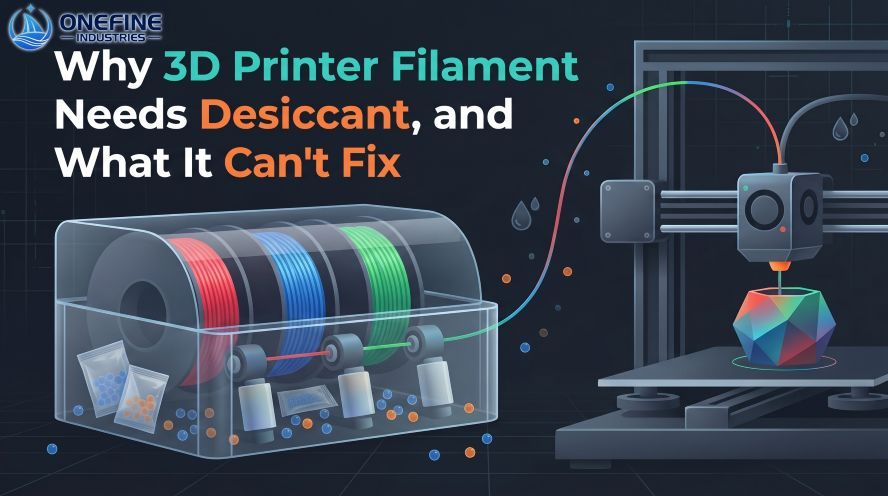
3D printer filament is plastic, but that doesn't make it immune to humidity. Several common filament materials are hygroscopic — they pull water vapor directly out of the surrounding air — and the amount varies enormously depending on the material's chemistry.
Why Some Filaments Absorb Moisture and Others Barely Do
Hygroscopicity in polymers comes down to molecular structure: materials with polar groups that can hydrogen-bond with water molecules absorb moisture readily, while more chemically inert polymers mostly shrug it off. Nylon is the clearest example — its amide groups bond with water efficiently, which is why nylon filament sits at the high end of moisture absorption. PETG falls in the middle, and PLA and ABS absorb comparatively little, though "comparatively little" still isn't zero.
The Materials Aren't Equally at Risk
- Nylon (PA/PA6): Very high absorption, roughly 2.5-9.5% of weight in water — the material most likely to need active moisture management
- PETG: Moderate absorption, roughly 0.5-2%
- PLA: Low-to-moderate absorption, roughly 0.3-1% — described in filament industry guidance as relatively forgiving compared to nylon, but still affected over longer exposure
- ABS: Low-to-moderate absorption, roughly 0.2-0.8%
These are typical ranges reported by filament retailer MatterHackers' own technical guidance, not a guarantee for every specific product — moisture uptake also depends on spool size, ambient humidity, and how long the filament sits exposed.
What Wet Filament Actually Looks Like When You Print It
Moisture absorbed into the filament doesn't stay liquid once it reaches the hot end — it flashes to steam almost instantly inside the nozzle. According to MatterHackers' own troubleshooting guidance, that shows up as audible popping, crackling, or sizzling sounds from the nozzle during printing, along with extra stringing between parts of the print, rough or pitted surface texture, inconsistent extrusion, and reduced layer adhesion or part strength. Other printer problems can cause similar symptoms, so moisture is one variable to check, not an automatic diagnosis.
Where Desiccant Fits and Where It Doesn't
A desiccant packet sealed inside a filament storage container does real, useful work: it keeps the air around the spool dry, so moisture never gets the chance to migrate into the material in the first place. According to 3D printing storage guidance from 3dprinterly, the target for that stored air is under 15% relative humidity — considerably drier than typical room air.
[Internal link] But that's prevention, not a cure. Once filament has already absorbed moisture, no amount of time next to a desiccant packet will pull that water back out — the same basic limitation covered in our guide on desiccant that's already been deployed vs. desiccant that hasn't: a sealed storage environment manages future moisture, it doesn't reverse moisture that's already inside the material. Actually drying out wet filament requires real heat, typically in the range of 50-70°C depending on the specific material, applied for a sustained period — which is a different process entirely from simply storing it next to desiccant afterward.
Key Differences at a Glance
- Desiccant in storage (prevention): Keeps ambient humidity low around unused filament, stopping moisture from getting in; works continuously as long as the desiccant itself isn't saturated
- Heat drying (cure): The only way to remove moisture already absorbed into filament; requires sustained heat at material-specific temperatures, not just dry air exposure
Recommended Products from Onefine
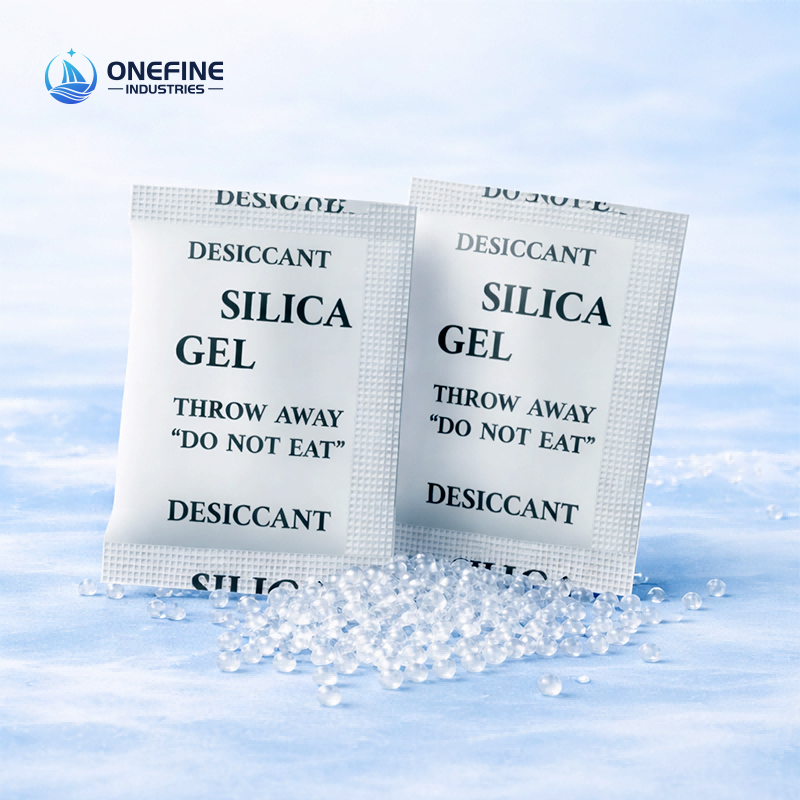
- Silica Gel Desiccant Sachet — sized for sealed filament storage containers; talk to us about quantity for your container volume
Need Desiccant for Sensitive Material Storage?
Onefine supplies silica gel desiccant sized for small, sealed storage environments where humidity needs to stay low. Tell us your container size and typical storage duration, and we'll help confirm the right quantity.
We provide:
- ✅ Silica gel desiccant for small, enclosed storage applications
- ✅ Retail-ready small-pack sizes and custom packaging options
- ✅ Worldwide shipping
- ✅ Technical support for confirming the right desiccant amount for your use case
- ✅ Fast quote response
Related Reading
How Long Does Unopened Desiccant Actually Last Before You Use It?
Desiccant doesn't sit on a shelf forever without a cost — but the number that matters depends on whether you mean "sealed in storage" or "already opened." Those are two very different clocks, and mixing them up is an easy way to waste capacity before a packet ever does its job.

How Much Desiccant Do You Actually Need?
Desiccant packaging follows a real industry standard (MIL-D-3464), not guesswork. Here's how the unit-based formula actually works, a worked example, and what the simplified version leaves out.