Why Food-Safe Desiccant Packets Still Say "Do Not Eat"
Key Takeaways
- Silicon dioxide (silica) is itself approved by the FDA for direct use in food — as an anticaking agent, up to 2% by weight, under 21 CFR 172.480 — a genuinely different regulatory category from a loose desiccant packet dropped into a food package.
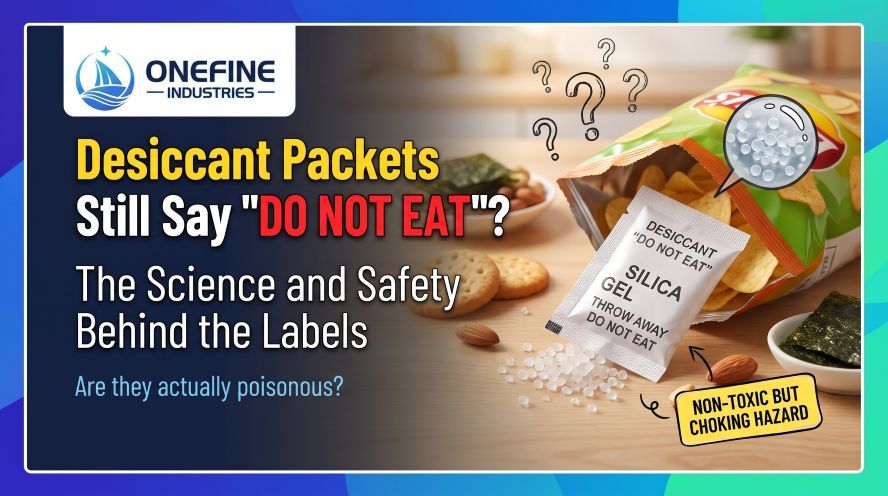
- A desiccant packet isn't reviewed or labeled as a food additive itself, so "do not eat" functions mainly as a choking-hazard and liability warning, not a toxicity alert — toxicology references classify ingested silica gel beads as essentially non-poisonous.
- "Food-safe" on a desiccant packet is actually three separate compliance determinations bundled together — the silica filling, the sachet material, and the printing ink each have their own basis — not one single approval covering the whole packet.
Desiccant packets slipped into food packaging almost always carry a warning: "Do Not Eat." Given how often it's accidentally ignored with no real consequence, it's worth asking what that label is actually protecting against — and the answer turns out to be more about regulatory categories and packaging risk than about poison.
Silica Is Already Approved to Be In Food — Just Not Like This
Under U.S. Food and Drug Administration regulation 21 CFR 172.480, silicon dioxide is a permitted food additive in its own right. It's used as an anticaking agent in an amount not exceeding 2 percent by weight of the food, as a stabilizer filtered out of beer during production, and as an adsorbent carrier for certain vitamins in tableted dietary foods. In other words, the same base chemical that makes up a desiccant bead has already been reviewed and approved by the FDA for actual ingestion, under specific purity, quantity, and use conditions.
That approval, though, covers silicon dioxide mixed directly into food as an ingredient — not a loose packet of desiccant beads placed inside the package next to the food. Sharing a chemical identity doesn't mean a desiccant packet has gone through the same additive-grade review for the quantities and form it actually comes in.
Why the Label Still Says Don't Eat It
Independent toxicology references are consistent on this point: silica gel itself carries essentially no poisoning risk. A Swiss toxicological information resource notes "none" as the danger of poisoning, describing the material as inert and excreted largely unchanged; mild stomach upset is an occasional but rare outcome of accidental ingestion. A university science-communication source adds that the real-world concern is less about chemistry and more about the packet itself — it resembles a condiment packet, and children in particular sometimes swallow it whole, creating a choking hazard rather than a poisoning one. The same source cites poison control centers logging hundreds of these accidental ingestions a year, overwhelmingly involving children, not adults misjudging the material's safety.
Put together, the "Do Not Eat" label isn't signaling that the contents are dangerous to touch or handle. It's a conservative, standardized warning that covers two separate risks at once — the physical choking hazard of swallowing a whole packet, and the simple fact that the packet was never reviewed or labeled as something meant to be eaten, whatever the underlying chemical turns out to be.
What "Food-Safe" Actually Means for a Desiccant Packet
A food-contact compliance statement for a food-grade desiccant sachet typically has to address three physically separate components, not one blanket claim:
- The silica filling itself — evaluated for suitability under the FDA's general safety standard for substances in contact with food, often documented against the USP/NF monograph for silicon dioxide as a quality benchmark
- The sachet material — a material like a spunbond olefin fabric has its own applicable regulation (21 CFR 177.1520, covering olefin polymers) with its own conditions, such as a temperature ceiling for safe contact
- The printing ink on the sachet surface — covered by a separate range of food-contact ink regulations rather than falling under the silica or sachet material rules
Key Differences at a Glance
- Food-additive-grade silicon dioxide (21 CFR 172.480): reviewed and approved for direct ingestion in controlled amounts, used as an anticaking agent, beer stabilizer, or dietary-tablet adsorbent
- Desiccant packet silica gel: the same base chemical, packaged as a loose, non-ingestible insert; not reviewed as a food additive itself; labeled "Do Not Eat" primarily for choking-hazard and liability reasons rather than documented toxicity
- A "food-safe" sachet claim: bundles three independent compliance determinations — filling, sachet material, and ink — rather than one single approval covering the packet as a whole
Recommended Products from Onefine
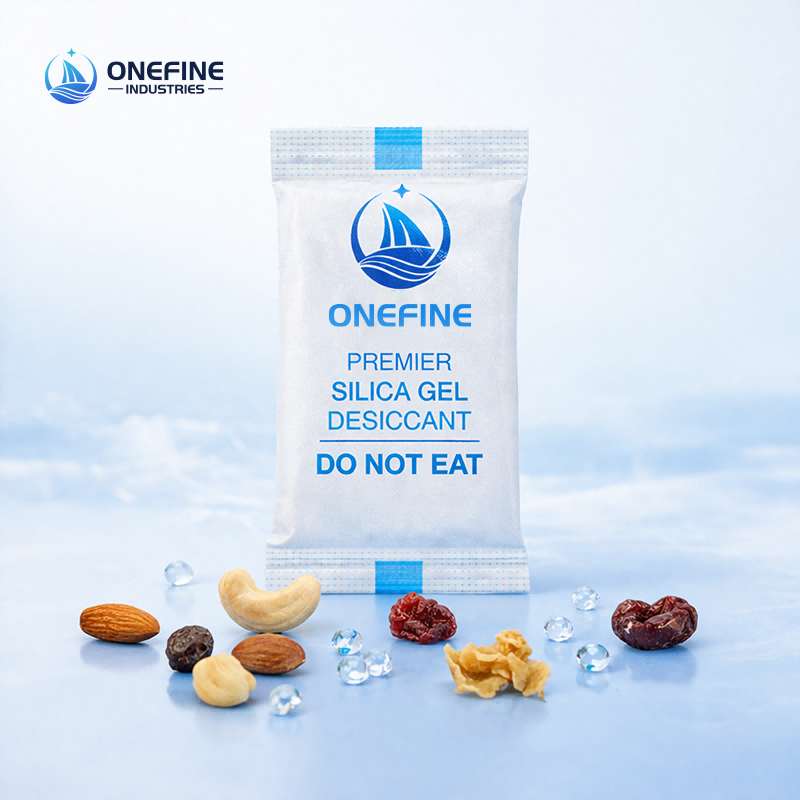
- Food Safe Desiccant Bags — silica gel desiccant in gram-weight small packs suited to food packaging use, sized to the product's packaging volume
Questions About Desiccant Compliance for Food Packaging?
Onefine supplies silica gel desiccant in formats built for food packaging environments. Tell us about your product and packaging format, and we'll help you choose the right size and setup.
We provide:
- ✅ Food-grade silica gel desiccant in gram-weight small packs
- ✅ Technical support for matching desiccant size to your packaging
- ✅ Custom packaging and private label options
- ✅ Worldwide shipping
- ✅ Multiple desiccant materials across our product range
Related Applications
Related Reading

How Much Desiccant Do You Actually Need?
Desiccant packaging follows a real industry standard (MIL-D-3464), not guesswork. Here's how the unit-based formula actually works, a worked example, and what the simplified version leaves out.
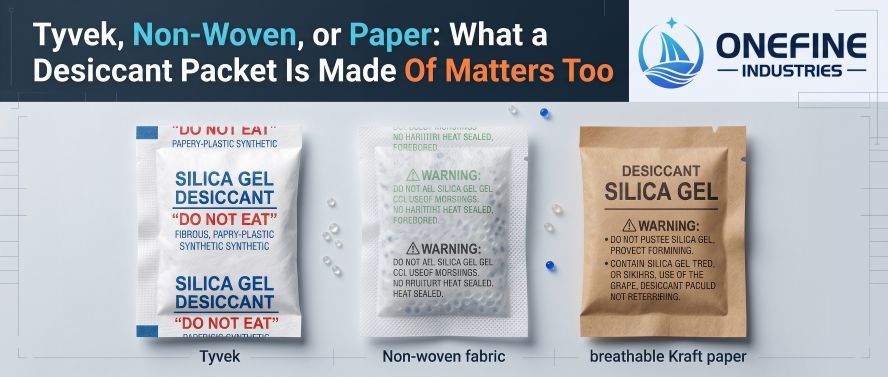
Tyvek, Non-Woven, or Paper: What a Desiccant Packet Is Made Of Matters Too
A desiccant packet's outer material isn't just packaging — it decides whether moisture vapor can get in and whether desiccant dust can get out. Here's how paper, non-woven fabric, and Tyvek actually compare on that trade-off.