Tyvek, Non-Woven, or Paper: What a Desiccant Packet Is Made Of Matters Too
Key Takeaways
- Dust-tightness and breathability usually pull against each other in packet materials — a sachet open enough to let moisture vapor through easily tends to also be more prone to letting fine desiccant dust leak out, so no material is a simple drop-in swap for another.
- Tyvek is unusual because of how it's actually made — continuous flash-spun HDPE filaments bonded into a sheet, not pulped or woven fiber — which lets it combine high moisture vapor transmission with strong particle-barrier performance at the same time, at a higher cost than paper or standard non-woven fabric.
- A sachet leaking desiccant dust is often as much a sealing-quality problem as a material problem — a well-sealed paper sachet can outperform a poorly sealed premium one, so material choice and seal quality both matter.
The desiccant inside a sachet gets most of the attention, but the packet holding it is doing real work too: it has to let water vapor pass through fast enough for the desiccant to adsorb it, while keeping the desiccant itself — and any dust it sheds — safely inside. Those two jobs don't automatically go together.
Why Packet Material Is a Trade-Off, Not Just a Spec Sheet Line
According to desiccant-packaging supplier Sorbent Systems' own selection guidance, a cover material's adsorption performance depends heavily on its water vapor transmission rate — but dust control for the product and a high transmission rate tend to work against each other within a single material, since the same porosity that lets vapor through readily also tends to let fine particles out. That's the core tension behind every packet-material choice, not a detail specific to one supplier's product line.
Paper: Cheapest and Most Breathable, but the Weakest When Wet
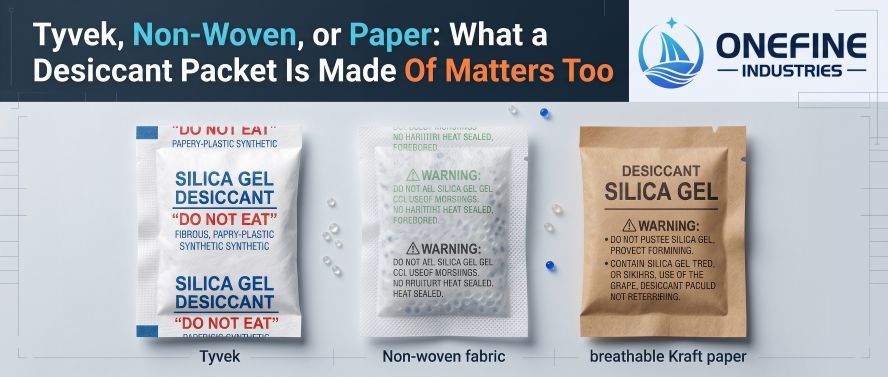
Paper sachets are built from pulped cellulose fiber — cheap, naturally breathable, and the traditional default for desiccant packaging. The trade-off shows up in how paper behaves once it's stressed: in DuPont's own material comparison testing (conducted for medical packaging, not desiccant sachets specifically, but testing the same underlying paper fiber structure), paper lost strength and puncture resistance when wet, and shed more airborne particulates than Tyvek when torn. Because that weakness comes from paper's basic pulp-fiber structure rather than anything specific to the medical packaging context, the same vulnerability carries over to paper desiccant sachets: a paper packet that gets damp or torn in transit is more likely to lose integrity than one made from a continuous-filament material.
Non-Woven Fabric: A Middle Ground Between Paper and Tyvek
Non-woven fabrics — typically polypropylene, polyethylene, or polyester fibers thermally bonded into a sheet — sit between paper and Tyvek on both cost and performance. According to nonwoven materials manufacturer Freudenberg's own product documentation, this bonding process gives the material strong tensile and tear strength and allows it to be heat-sealed without chemical binders, which keeps manufacturing efficient. It's a widely used, moderately priced alternative to Tyvek for desiccant bags, though its specific breathability and dust-control performance depends on the particular fiber blend and bonding density used.
Tyvek: Solves Both Problems at Once, at a Higher Price
Tyvek isn't paper at all, despite looking similar — DuPont describes it as flash-spun, continuous high-density polyethylene filaments, randomly oriented and bonded by heat and pressure into a single sheet. That continuous-filament structure is what lets it do something paper and most non-woven fabrics can't do as well simultaneously: allow a high moisture vapor transmission rate while also resisting particle penetration, because there's no loose or pulped fiber to shed in the first place. Tyvek is also hydrophobic and keeps its strength whether wet or dry, unlike paper. [Internal link] Sorbent Systems' own guidance is direct about the trade-off: Tyvek doesn't reduce the desiccant's adsorption rate and doesn't release dust, but it costs more than conventional desiccant packaging materials — which is a different question from how much desiccant a product's own packaging requires; here, the packet material in question is the desiccant's own wrapper, not the shipping box or bag it ends up inside.
Material Alone Doesn't Guarantee a Dust-Tight Sachet
Even the best material choice doesn't eliminate the risk entirely. [Internal link] Real-world complaints about leaking desiccant beads — the same practical concern behind why food-safe desiccant packets carry a "do not eat" warning — often trace back to sealing quality rather than the material itself: a poorly sealed sachet can leak regardless of what it's made from, while a well-sealed paper sachet can hold up better than a premium material with a weak seal.
Key Differences at a Glance
- Paper: Lowest cost, naturally breathable, loses strength and sheds more particulates when wet or torn
- Non-woven fabric (PP/PE/PET): Mid-range cost, strong tear resistance, heat-sealable, breathability and dust control vary by specific fiber blend
- Tyvek: Highest cost, combines high moisture vapor transmission with strong dust/particle barrier via its continuous-filament structure, keeps strength wet or dry
Recommended Products from Onefine
- Silica Gel Desiccant Sachet — available in different packet material options; talk to us about which material and sealing spec fits your application and budget
Need Help Matching Packet Material to Your Application?
Onefine supplies silica gel desiccant with packaging material options to fit different performance and budget needs. Tell us your application, and we'll help confirm the right packet material and sealing spec.
We provide:
- ✅ Silica gel desiccant for general packaging and shipping applications
- ✅ Multiple packet material options available on request
- ✅ Retail-ready small-pack sizes and custom packaging options
- ✅ Worldwide shipping
- ✅ Fast quote response
Related Reading
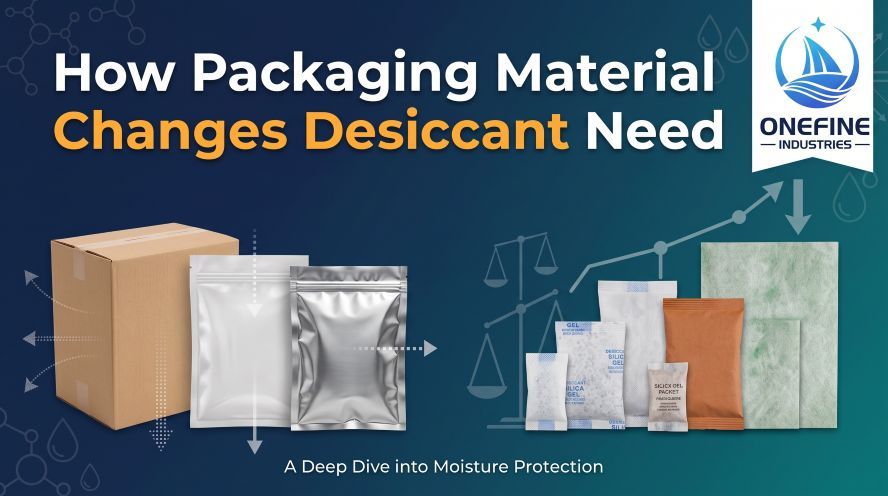
How Packaging Material Changes Desiccant Need
How much desiccant you need is not just about container volume. The packaging material itself lets moisture through at very different rates, and that single factor can change your desiccant requirement by two orders of magnitude.
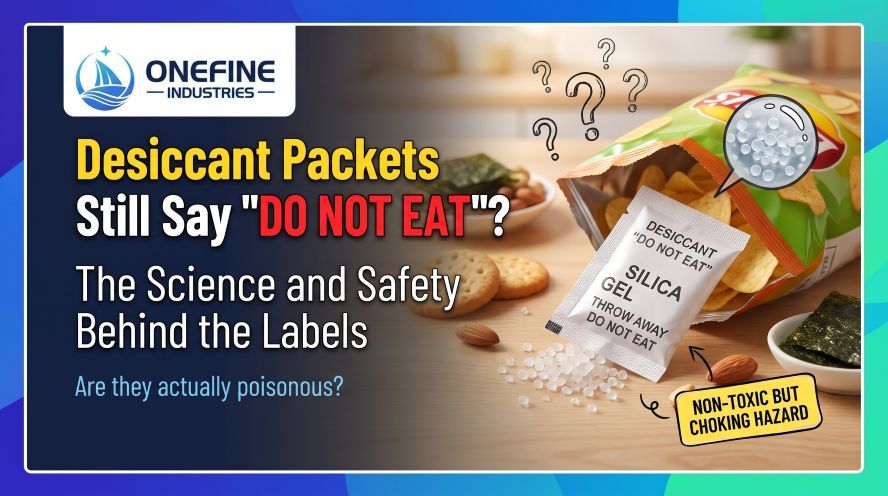
Why Food-Safe Desiccant Packets Still Say "Do Not Eat"
Silica gel is FDA-approved as a food additive at up to 2% by weight. So why do packets still warn against eating it? It is about packaging, not poison.
How Long Does Unopened Desiccant Actually Last Before You Use It?
Desiccant doesn't sit on a shelf forever without a cost — but the number that matters depends on whether you mean "sealed in storage" or "already opened." Those are two very different clocks, and mixing them up is an easy way to waste capacity before a packet ever does its job.
Silica Gel Sachet Damage and Dust: A Receiving Inspection Guide
A practical receiving guide for silica gel sachets: inspect seams, loose particles and protective packaging, then document defects against agreed purchase requirements.