Oxygen Absorber cc Ratings: Why Capacity Is Not Package Volume
Key Takeaways
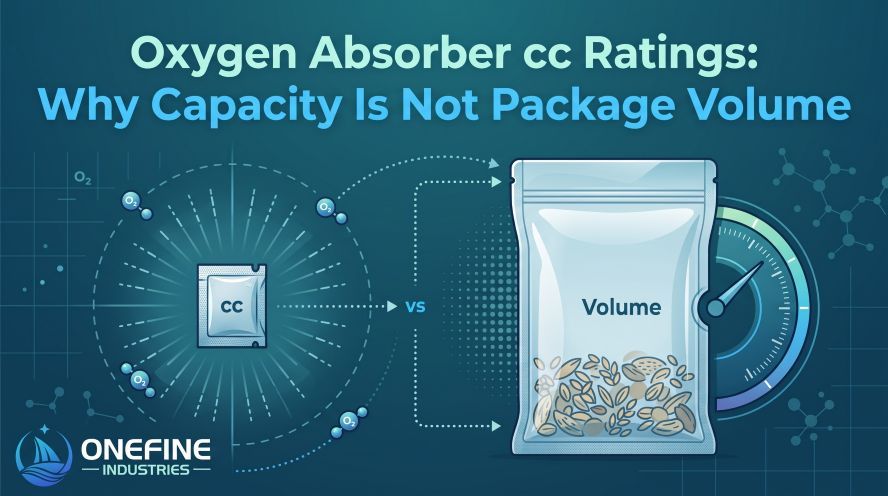
- An oxygen-capacity rating describes a volume of oxygen under specified conditions, rather than the total volume of the container or the packet's weight.
- Available gas space and its oxygen concentration provide an initial oxygen estimate. That estimate alone does not establish the final sachet requirement.
- Ask for the capacity basis, suitable absorber type and removal time together. Validate the complete package rather than buying by a model number alone.
Intro
A buyer requests an oxygen absorber for a 500 mL pouch and receives a question: how much oxygen must be removed? The pouch size is useful, but it does not answer that question by itself. Confusing the volume of air with the volume of oxygen can produce a misleading capacity request.
Onefine's food oxygen absorber sachets use capacity models rather than the gram-weight selection used for many desiccants. This guide explains what information belongs in a sizing inquiry. It does not provide a universal packet-per-bag chart or establish a food's safe storage life.
What the cc Number Measures
One cubic centimetre, written cc, equals one millilitre. For an oxygen absorber rated in cc of oxygen, the number refers to oxygen-removal capacity under the specified conditions. It does not mean that the packet is the same physical volume or protects only that volume of packaging.
Mitsubishi Gas Chemical's AGELESS manual defines its size numbers using nominal oxygen capacity and separately defines the time needed under specified conditions. That distinction matters when comparing quotations: capacity and reaction time are separate requirements. AGELESS model definitions are not a certification or performance specification for Onefine sachets.
Ask the supplier to write out the rating basis. “100 cc oxygen capacity” is clearer than an unexplained “100#” code. Confirm the selected model's conditions and documentation instead of assuming all brands interpret their codes identically.
Calculate the Initial Oxygen, Not the Outside Bag Dimensions
For ordinary air, an initial estimate uses approximately 21% oxygen by volume. Multiply the estimated gas volume by 0.21. Mitsubishi Gas Chemical Trading's technical guide uses this relationship in its packaging calculation examples.
Consider a deliberately simplified example: a closed package contains 400 mL of ordinary air. Its initial gas-phase oxygen is approximately 400 × 0.21 = 84 mL, or 84 cc. This is arithmetic, not a measurement of an actual Onefine package or a recommendation to select a particular model.
The example leaves a separate task: determine the gas volume. Do not substitute the full nominal package volume if the contents occupy much of it. Conversely, do not assume that the visible space above the contents captures all air between loose pieces. Record how the estimate was made and review it with the packaging supplier.
For gas-flushed packaging, use the established residual oxygen concentration. If the same hypothetical 400 mL gas volume contains 3% oxygen, its initial oxygen is 400 × 0.03 = 12 cc, rather than 84 cc. The 3% value is an illustration, not a recommended limit; verify the actual sealed-package concentration.
Why the First Calculation Is Not the Final Selection
The 84 cc example describes only the oxygen in the assumed starting gas volume. It says nothing about how well the complete package performs during storage. Keep that boundary visible when the calculation is forwarded for quotation.
Mitsubishi Gas Chemical's usage precautions require an appropriate barrier enclosure, complete sealing, a suitable absorber type and size, and correct handling. These are interdependent conditions. A larger nominal capacity cannot by itself demonstrate that a leaking package or unsuitable absorber type will meet the requirement.
A second hypothetical calculation shows the missing term. Suppose a validated assessment supports net oxygen entry of 0.30 cc per finished package per day under the intended conditions. Over 180 days, that contributes 54 cc. Added to the 84 cc initial estimate, the subtotal becomes 138 cc, before other identified oxygen sources or a justified design allowance. None of these numbers is a Onefine test result or final model selection.
This arithmetic assumes the stated entry rate remains applicable. A film value expressed per square metre and per atmosphere cannot be inserted as a finished-package daily rate without accounting for area, driving force and test conditions. Ask the packaging specialist to establish that conversion and assess seals; do not invent a universal safety multiplier.
Our oxygen absorber chemistry guide explains the reaction separately. This selection review concerns the capacity and package evidence needed to put that mechanism to useful work.
Compare Capacity and Removal Time Separately
A quotation should address oxygen capacity and the time to reach the agreed endpoint under the intended conditions. Capacity alone does not establish immediate removal.
For a trial, agree the fill arrangement, sachet placement, sealing process, measurement schedule and acceptance endpoint. Keep sample conditions comparable.
Record the sachet batch and handling history as well. A result is more useful when it can be connected to the actual packet and packaging process. Our bag appearance guide explains why visible pouch shrinkage is not a reliable substitute for oxygen-performance evidence.
Key Differences at a Glance
- Container volume: the enclosure's nominal capacity; not automatically the volume of gas after filling.
- Gas volume: the space occupied by gas in the filled package; used with oxygen concentration for an initial estimate.
- Oxygen capacity: the selected absorber's specified oxygen-removal quantity under stated conditions.
- Removal time: a separate performance requirement that must be assessed for the intended package.
How to Prepare a Useful Inquiry
Send the product description, package size and fill amount, together with how gas space was estimated. State whether the package contains ordinary air or uses a controlled gas process, and provide residual oxygen evidence when available.
Include the film or container construction, closure method, intended storage conditions and required storage period. Ask which absorber type, capacity model and trial method fit those inputs. Keep unknowns explicit so they are resolved before a model is treated as approved.
Compare offers against the same inquiry. Confirm whether the quotation identifies oxygen capacity, suitable conditions and supporting documents. Avoid selecting solely by packet dimensions, sachet weight or an unexplained number on the wrapper.
Recommended Products from Onefine
- Food Oxygen Absorber Sachets — the directly relevant product for a capacity-model inquiry. Confirm the selected model, format and application suitability with Onefine; other brands' test conditions are not transferred to this product.
FAQ
Does a 100 cc rating mean a 100 mL package?
No. Confirm that it denotes oxygen capacity. Package volume and oxygen volume are different quantities.
Can I choose a sachet from the 84 cc example?
Not from that arithmetic alone. The actual gas volume, absorber type, package barrier, handling and acceptance requirements still need review.
Does extra capacity establish food safety or shelf life?
No. Oxygen removal does not establish a validated food-storage process. Retain the product's required temperature controls and food-specific safety assessment.
Need an Oxygen Absorber Model for Your Packaging?
Onefine supplies small-format oxygen absorber sachets. Send your product, gas-space estimate, packaging construction and intended storage conditions for a model-specific discussion.
We can discuss:
- The requested oxygen-capacity model
- Sachet and strip-format requirements
- Selected-product documentation
- Custom packaging and private-label inquiries
- Model-specific order quantities and quotations

Related Reading
How Oxygen Absorbers Actually Work
An oxygen absorber sachet is not a desiccant in disguise. It works through an actual iron oxidation reaction that consumes oxygen as it runs, and that reaction needs a bit of moisture to proceed. Here is the real chemistry behind it.
Why Oxygen Absorbers Do Not Always Make Bags Look Vacuum-Packed
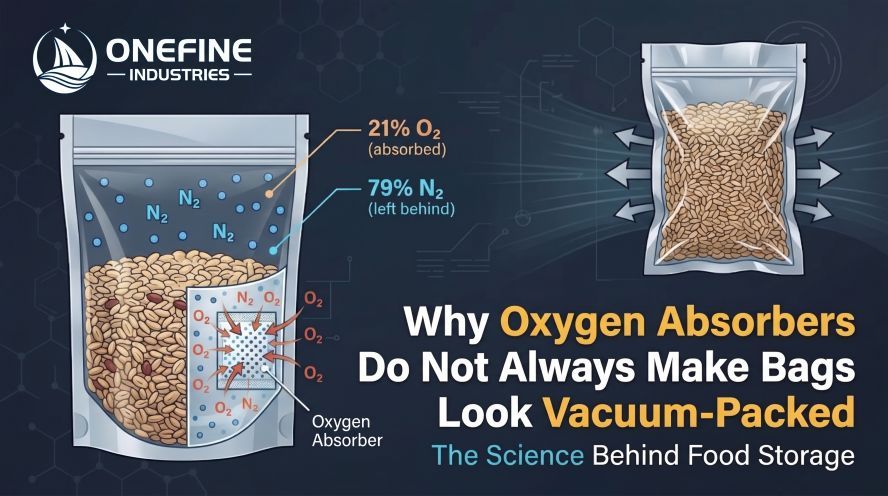
A sealed pouch can retain its shape after oxygen removal. Learn why nitrogen remains, what bag appearance cannot prove, and how to check packaging performance.