Why Oxygen Absorbers Do Not Always Make Bags Look Vacuum-Packed
Key Takeaways
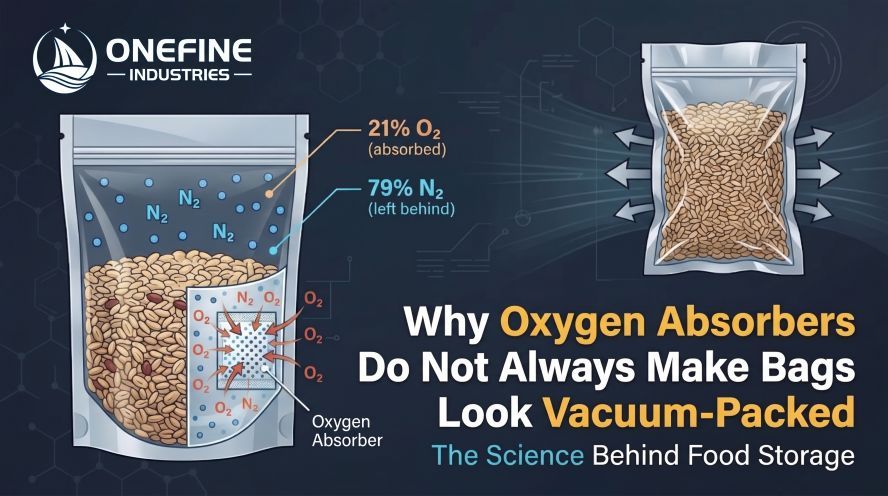
- Oxygen absorbers remove oxygen rather than all the gas in a sealed package; nitrogen largely remains.
- A pouch that stays loose is not, by appearance alone, proof of absorber failure, and a tight pouch does not verify residual oxygen.
- Assess the absorber, package barrier and seal as one system; confirm performance against the intended product and storage conditions.
You seal a pouch with an oxygen absorber and return later expecting a tight, vacuum-packed shape. The pouch still looks loose. Does that mean the packet failed?
Appearance alone cannot answer the question. An oxygen absorber changes the gas mixture inside the package, while a vacuum sealer mechanically removes gas. The two processes can produce different visual results. Understanding that distinction prevents both unnecessary rejection of good packaging and false confidence in packaging that merely looks tight.
Oxygen Removal Leaves Much of the Air Behind
Ordinary air contains approximately 21% oxygen and 78% nitrogen, with other gases making up the remainder. Iron-based absorbers react with oxygen; they do not remove the nitrogen in the same way.
Our guide to oxygen absorber chemistry explains the underlying reaction. Here, the practical consequence is the focus: even successful oxygen removal leaves a substantial amount of gas inside the package.
Consider 1,000 mL of ordinary air, measured at a stated temperature and pressure. Its initial oxygen contribution is approximately 210 mL under the same conditions. This simple composition estimate illustrates why removing oxygen is different from evacuating the whole package. It is not a packet-sizing recommendation: actual oxygen demand also depends on the packaged product and the intended storage system.
Why Some Pouches Pull In More Than Others
Removing gas can cause flexible packaging to pull inward, but the visible change depends on the package and its contents. A bag filled with granules can behave differently from one containing a powder. A rigid container cannot show the same inward movement as a flexible pouch.
The Church of Jesus Christ of Latter-day Saints' own dry-food packaging guidance describes slight inward movement in sealed pouches and says it is more noticeable with granular foods than powdered products. That observation concerns its packaging system; it does not establish a universal timetable or required appearance for every commercial pouch.
Therefore, expecting every package to become brick-hard introduces an acceptance rule that may have little relationship to the oxygen specification. Document the intended test instead of asking staff to judge performance by squeezing the bag.
A Tight Bag Does Not Verify Oxygen Concentration
Visual appearance does not provide a numerical residual-oxygen result. A pouch may look compact because air was mechanically expelled before sealing. Another may retain shape while oxygen is being consumed. Neither observation measures the remaining oxygen concentration.
For product development or quality control, define an appropriate residual-oxygen test and acceptance limit with the packaging specialist. A qualified headspace measurement can address a different question from a seal-integrity test. Both may be necessary, but they are not interchangeable.
The same distinction applies to time. Do not treat an assumed overnight waiting period as universal evidence of success or failure. Reaction time depends on the absorber grade and packaging conditions. Mitsubishi Gas Chemical's AGELESS instructions explicitly describe nominal capacity and deoxygenation time under specified conditions; those brand-specific conditions are not Onefine performance guarantees.
Check the Whole Package Before Blaming the Packet
Investigate three separate parts of the system:
- Absorber suitability: Confirm the grade, oxygen-capacity requirement and handling history. Packet mass alone does not identify oxygen capacity.
- Package barrier: Confirm that the material is suitable for the intended storage period and product. A visually intact bag is not automatically an adequate oxygen barrier.
- Seal integrity: Review whether the closure is continuous and whether product contamination or damage could interfere with it.
Onefine's oxygen absorber sachets are specified by capacity model rather than the gram-weight logic used for many desiccant packets. Discuss the actual requirement instead of choosing a sachet simply because it looks larger.
Replacing the packet without checking the bag and seal can leave the underlying problem unresolved. Conversely, a verified package design should not be rejected solely because it fails an informal visual expectation.
Key Differences at a Glance
- Oxygen absorber: Chemically consumes oxygen within its confirmed capacity and operating conditions.
- Vacuum sealing: Mechanically removes gas before closure; the result depends on the packaging process.
- Moisture-control packet: Addresses a different packaging requirement and is not a substitute for oxygen removal.
Our packaging material guide explains why the outer package matters for moisture control. The related lesson here is to evaluate the enclosure and packet together, while keeping oxygen transmission and water-vapor transmission as distinct properties.
How to Choose a Useful Acceptance Check
Before purchasing, state the product, package dimensions, filling arrangement, barrier construction and storage conditions. Ask what oxygen-capacity model and verification method suit that combination.
During a packaging trial, record the absorber batch and exposure history, sealing conditions and test results. Compare like-for-like packages. If a result is unexpected, preserve the evidence rather than repeatedly opening and resealing the same test pouch and treating it as unchanged.
Reduced-oxygen packaging is not a general food-safety process. Utah State University Extension cautions that removing oxygen does not replace required refrigeration or freezing and that moist foods in reduced-oxygen conditions can present a botulism hazard. Follow food-specific validated guidance; this article does not establish a safe shelf life or authorize room-temperature storage of a new product.
Recommended Products from Onefine
- Food Oxygen Absorber Sachets: Request a capacity model and packaging review matched to the intended food and enclosure.
Need Oxygen Absorber Sachets for Your Packaging?
Onefine supplies small-format packaging sachets. Share your product and package details so the request can be reviewed against the intended application.
We provide:
- ✅ Oxygen-capacity model discussions
- ✅ Sachet options for retail packaging projects
- ✅ Custom and private-label inquiries
- ✅ Packaging-specific quotation support
- ✅ Documentation requests for the selected product
Contact us to confirm suitability, available specifications and order requirements.

Related Reading
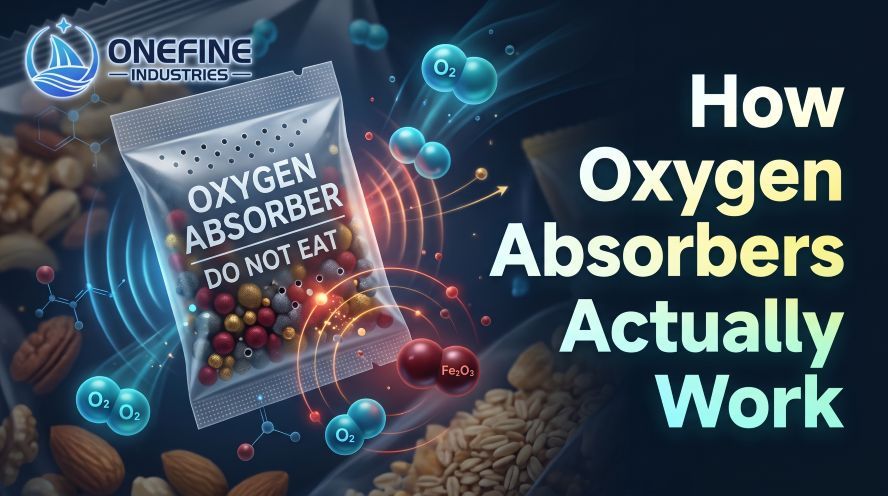
How Oxygen Absorbers Actually Work
An oxygen absorber sachet is not a desiccant in disguise. It works through an actual iron oxidation reaction that consumes oxygen as it runs, and that reaction needs a bit of moisture to proceed. Here is the real chemistry behind it.
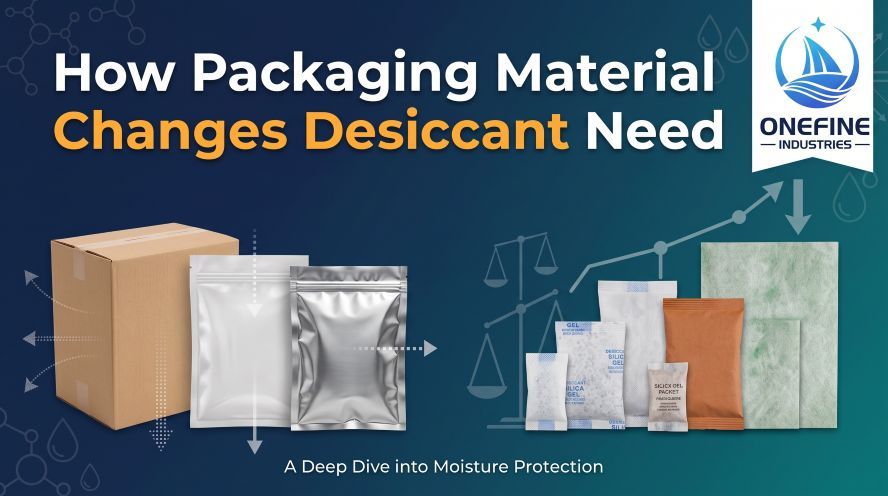
How Packaging Material Changes Desiccant Need
How much desiccant you need is not just about container volume. The packaging material itself lets moisture through at very different rates, and that single factor can change your desiccant requirement by two orders of magnitude.
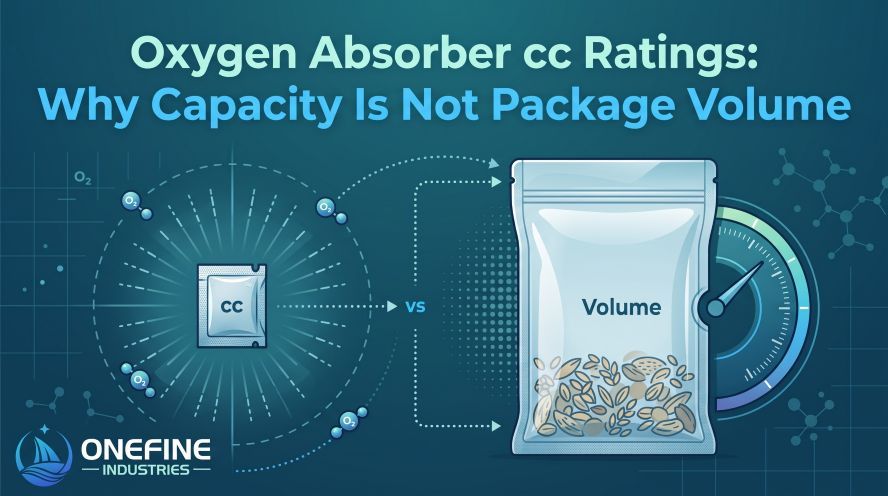
Oxygen Absorber cc Ratings: Why Capacity Is Not Package Volume
A 100 cc oxygen absorber is rated for oxygen, not a 100 cc container. Learn how gas volume, residual oxygen and packaging conditions affect a sizing inquiry.