Key Takeaways
- Every packaging material has a moisture vapor transmission rate (MVTR) — how much water vapor leaks through it over time — and this rate varies enormously between material types, not just a little.
- A foil-laminate barrier bag can have an MVTR hundreds of times lower than a basic barrier film, which directly determines how much desiccant is actually needed to maintain a target humidity level over your intended storage duration.
- This is the detail our earlier guide on desiccant sizing flagged but didn't quantify — packaging material choice isn't a footnote to the calculation, it can be the single biggest variable in it.
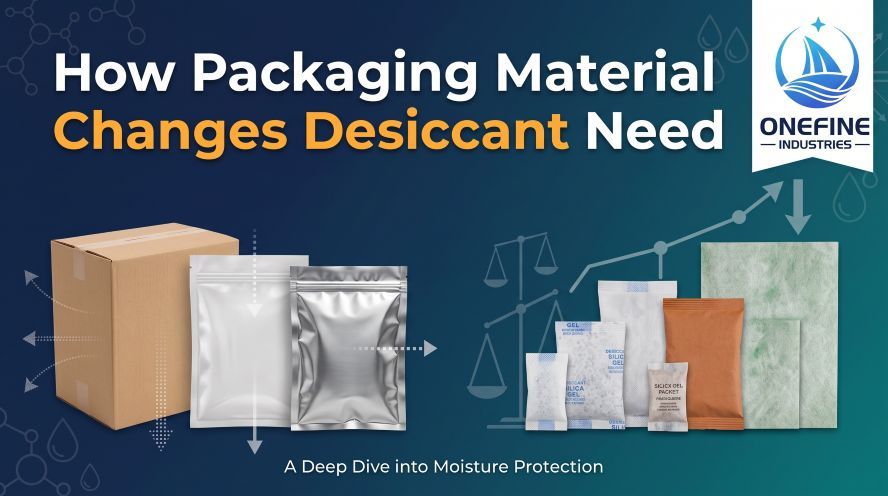
In an earlier guide on desiccant sizing, we flagged packaging material permeability as one of the things a simple volume-based formula doesn't account for. It's worth coming back to with actual numbers, because the effect isn't minor — it's often the single largest variable in how much desiccant a sealed package actually needs.
What MVTR Actually Measures
Moisture vapor transmission rate (MVTR, sometimes called WVTR) describes how much water vapor passes through a given area of packaging material over a set time period, typically expressed in grams per 100 square inches per 24 hours. No packaging material is a perfect moisture barrier — even materials that look and feel completely sealed let some water vapor through, just at very different rates depending on what they're made of.
How Much the Material Actually Matters
Industry reference data on moisture barrier bag materials, drawn from the ASTM F1249 standard test method and EIA 583 barrier classifications, shows just how wide this range is:
- Basic barrier films (the kind of clear or lightly metallized film used for lower-cost packaging) can run an MVTR in the range of 0.05 to 0.1 g/100in²/24h
- Mid-grade aluminized polyester laminates bring that down to roughly 0.02 to 0.04 g/100in²/24h at common gauges
- Heavier aluminized polyester laminates can reach roughly 0.005 to 0.009 g/100in²/24h
- Foil-laminate barrier bags (nylon/foil/poly or similar constructions) can achieve an MVTR below 0.0003 g/100in²/24h — hundreds of times lower than a basic barrier film
The practical consequence of this range is dramatic. One published engineering example: for an identical 16" x 18" bag sealed for 12 months at a 20% maximum interior humidity target, a package using a barrier material rated at MVTR <0.02 needed roughly 6.6 units of desiccant — while the same bag built from a foil-laminate material rated at MVTR <0.0003 needed only about 0.01 units. Same size, same target humidity, same storage duration — a roughly 660x difference in desiccant requirement, driven entirely by the packaging material itself.
Why This Matters More Than It Looks Like It Should
This explains something that can otherwise seem inconsistent: two sellers can both follow the same desiccant-sizing formula and legitimately arrive at very different desiccant quantities for what looks like a similar-sized package, because the formula's result depends heavily on which packaging material is actually being used. It also means that switching to a lower-MVTR packaging material and switching to more desiccant are, to some extent, substitutes for each other — a tighter barrier material can reduce how much desiccant you need, while a looser one increases it, for the same target humidity and storage duration.
There's a cost trade-off worth being direct about: lower-MVTR materials (foil laminates, heavier barrier constructions) typically cost more per unit of packaging than basic barrier film, so the right balance between "spend more on better packaging material" and "spend more on desiccant" depends on your specific cost structure and storage duration — not a fixed rule that favors one approach in every case.
Key Differences at a Glance
- Basic barrier film: MVTR roughly 0.05-0.1 g/100in²/24h — needs the most desiccant for a given target humidity/duration
- Mid-grade aluminized laminate: MVTR roughly 0.02-0.04 g/100in²/24h — moderate desiccant requirement
- Heavy aluminized laminate: MVTR roughly 0.005-0.009 g/100in²/24h — meaningfully lower desiccant requirement
- Foil-laminate barrier bag: MVTR below 0.0003 g/100in²/24h — can reduce desiccant requirement by two or more orders of magnitude versus basic film
What This Means for Your Packaging
If you're trying to hit a specific target humidity for a specific storage duration, the packaging material you choose isn't a side detail — it's one of the two main levers you have, alongside desiccant quantity. Before finalizing a desiccant order based on container volume alone, it's worth confirming the MVTR of your actual packaging material, especially for longer storage durations or more moisture-sensitive products, where the gap between a basic film and a proper barrier material compounds significantly over time.
Recommended Products from Onefine
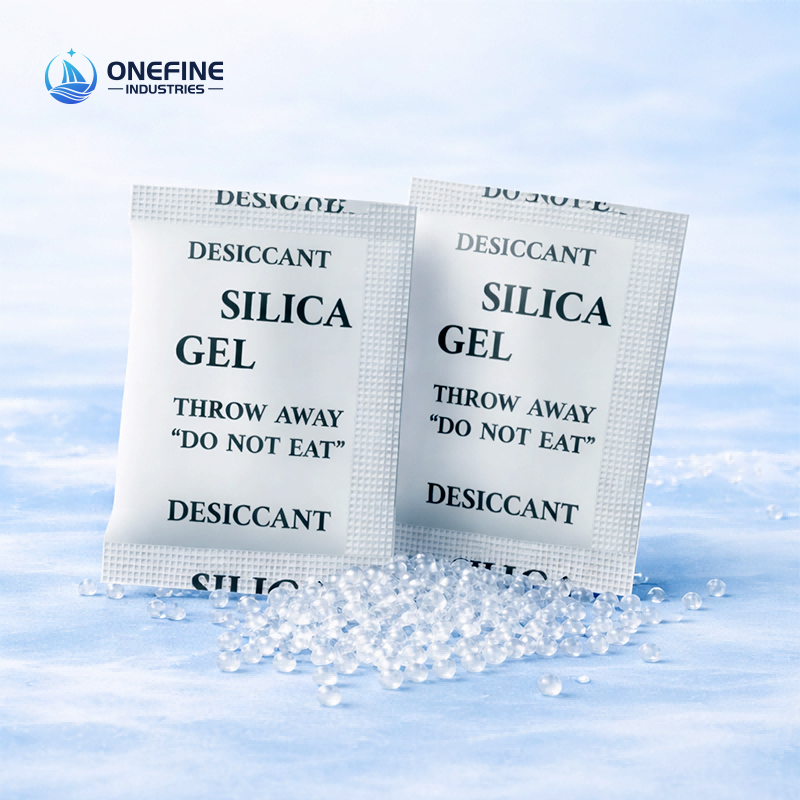
- Silica Gel Desiccant Sachet — general-purpose desiccant, sizeable to match your packaging material's actual permeability and your storage duration (already linked above)
Not Sure How Your Packaging Material Affects Desiccant Need?
Onefine supplies desiccants across a full range of pack sizes. Tell us your packaging material, target humidity, and storage duration, and we'll help you size the right amount rather than guess.
We provide:
- ✅ Full range of pack sizes for different packaging materials and durations
- ✅ Multiple desiccant materials to match your sizing needs
- ✅ Custom packaging and private label options
- ✅ Worldwide shipping
- ✅ Technical support for sizing your specific packaging