Key Takeaways
- Use dry silica gel when the packaging objective is moisture removal.
- Use conditioned silica gel when a suitable enclosure needs to hold humidity near a chosen range.
- Measure humidity inside the enclosure to check either approach.
What conditioning changes
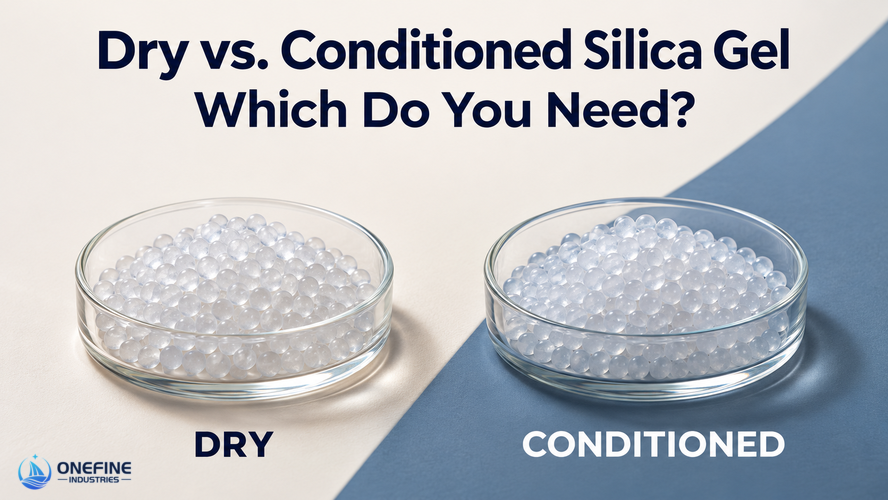
Conditioning brings a silica gel sorbent into equilibrium near a chosen relative humidity before use. As humidity in an enclosure shifts above or below that starting point, a suitable sorbent can take up or release moisture. Dry silica gel starts with comparatively little water and can initially pull moisture from the air and nearby materials.
Key Differences at a Glance
- Dry silica gel: Evaluate its moisture uptake over the expected storage or shipping period. Estimate the ongoing moisture load from the package and its contents, as well as moisture entering from outside.
- Conditioned silica gel: Choose a product with buffering data near the desired relative humidity. Its effectiveness depends on enclosure leakage, room conditions and how well air circulates between the sorbent and the object.
How to Choose
Start with the object's acceptable humidity range. For an ordinary retail product that needs a drier sealed package, evaluate a dry sachet and test the packed unit. For an object that needs a stable band, establish the target first and consult a conservator for valuable or sensitive objects. Test the enclosure with a logger placed near the object, where the reading represents its actual exposure. If humidity drifts, inspect the seal, routine opening schedule and air path to the sorbent before adding more material.
Start with the moisture job
Two boxes of the same size can call for different sorbents. A sealed retail package containing a moisture-sensitive accessory may need to stay below an upper humidity limit for shipping and storage. An enclosure for a collectible may instead need a stable band, with both an upper and a lower limit. Write the requirement as a condition the packed item must experience over time. A single humidity reading immediately after sealing cannot tell you whether either requirement has been met.
Record where the package travels, how long it stays closed, how often it is opened and what happens when it comes back into use. A package that is opened daily exchanges air repeatedly, while one that stays closed may be more affected by the barrier and the moisture initially packed with the item. These details tell you what to test and what a disappointing result might mean.
Run a side-by-side test in the final package
Prepare comparable test packs with the same enclosure, fill, seal and starting conditions. Where practical, use a control with no sorbent. Give each test pack an identifier and record the sorbent type, its condition at packing and its location. If a conditioned product is being considered, retain the supplier’s data for the intended humidity range and note how it was handled before sealing.
Place loggers where the readings represent the item’s exposure without obstructing the seal. Keep track of both temperature and relative humidity. Compare the initial response, the highest and lowest readings during storage and what happens after a planned opening. A dry sachet may be useoseful when the main concern is a high reading. For a storage band, look at both limits and the duration of excursions before choosing a product.
Diagnose the pattern before changing sachets
If the package starts humid and then gradually reaches the target, review what was packed inside and how long it takes the enclosure to settle. If humidity improves initially but later drifts upward, check the seal, exposure history and the barrier before assuming that more sorbent will solve it. When several packs behave differently, compare closure quality and opening history before changing every pack in the trial.
If the sorbent is in a separate compartment, check that air can actually move between that compartment and the item. Keep the logger near the item so you do not mistake a favorable reading next to the sachet for the condition at the product. A test that only measures the sorbent compartment can miss a problem on the other side of a divider.
Use the same logic for collectible storage
A collector might move a box between a display room and storage and open it repeatedly to inspect the contents. Here the trial should reproduce routine openings instead of treating the box as a sealed shipping pack. Record what happens after each opening and whether conditions recover between openings. For a sensitive or valuable collection, establish the permitted humidity band with the owner or conservator before changing the enclosure. Packaging trials with ordinary retail goods do not establish safe preservation conditions for a collection.
Specify the outcome before placing an order
Share the item, enclosure dimensions and materials, closure type, access schedule, typical environment and expected storage period. Describe the required outcome and provide any test readings you already have. For a dry sachet, ask what uptake data are available at relevant humidity and temperature. For a conditioned product, ask how it was prepared, how it should be kept before use and what data support the intended buffer range.
Agree on what a successful trial means before it starts. A purchaser may require that the package stays below a limit throughout shipment. A collector may need it to stay within a band and return to that band after opening. Give each purpose its own acceptance criteria and keep the trial records with the packaging specification.
After choosing the packaging configuration, repeat the trial on a small production run. Check that operators can reproduce the seal and sachet placement at normal packing speed. Keep the successful pack as a reference for incoming materials and future changes to the enclosure.
Recommended Products from Onefine
Consider silica gel sachets for packaged goods where testing supports dry moisture control. For a project that needs conditioned media, ask for product-specific evidence at the target humidity before selecting a format.
Need help choosing a sachet?
Send the package dimensions, product type, storage duration and humidity goal. We can help you compare:
- Sachet formats suitable for the enclosure
- Packaging and handling requirements
- Product information needed for an enclosure trial

Related Reading

Why Is Humidity Still High with Desiccant in a Sealed Box?
Troubleshoot high humidity in a storage box: check the meter, closure, damp contents and packet condition before changing your desiccant setup.

How Packaging Material Changes Desiccant Need
How much desiccant you need is not just about container volume. The packaging material itself lets moisture through at very different rates, and that single factor can change your desiccant requirement by two orders of magnitude.